Tiny Urban Kitchen

Exploring Food from Boston to Hong Kong and Beyond

  • About Me
  • Travel
  • Recipes
  • Michelin
  • Subscribe
  • Taiwanese
menu icon
go to homepage
  • About Me
  • Travel
  • Recipes
  • Michelin
  • Subscribe
  • Taiwanese
    • Email
    • Facebook
    • Instagram
    • LinkedIn
    • Pinterest
    • Twitter
    • YouTube
  • subscribe
    search icon
    Homepage link
    • About Me
    • Travel
    • Recipes
    • Michelin
    • Subscribe
    • Taiwanese
    • Email
    • Facebook
    • Instagram
    • LinkedIn
    • Pinterest
    • Twitter
    • YouTube
  • ×
    Home » You searched for tokyo sushi

    Search Results for: tokyo sushi

    Kikunoi (Akasaka)

    December 5, 2012 by Jennifer Che

    Untitled
    This is the first post in the series titled Tasting Tour of Tokyo detailing my recent trip to Japan.

    One negative aspect of being a tag-along on your husband's business trip is that you're often alone. After all, he's in the destination to work, which means he can't hang out with you during much of the trip.

    Thankfully, Tokyo is an easy city to navigate, and at this point, I know it quite well. I was perfectly happy to spend my afternoons shopping, exploring, and even visiting friends while he was at his conference.

    Unfortunately, there were a few nights where he had business dinners and couldn't even eat with me.

    Last time that happened, I bought simple take-out at the local depachika (basement of the department store) and ate in my hotel room. This time, I decided to head out into the city and dine solo at one of the most famous kaiseki establishments in Tokyo.
    Untitled
    Kikunoi specializes in Japanese kaiseki cuisine, a traditional, multi-course, Japanese meal. Kaiseki meals typically involve the use of fresh, seasonal ingredients prepared in such a way as to emphasize their flavors. The entire experience is a big part of kaiseki cuisine, and therefore the ambiance of the surroundings as well as the artistic presentation of the food are also very, very important.

    Kaiseki has been around for over 500 years, starting back in the 1600's when Sen no Rikyu, a tea master in Kyoto, felt that the powdered green tea used during tea ceremonies was too strong for an empty stomach, and needed some food to accompany it.
    Untitled
    The original kaiseki meals consisted of just miso soup with three sides, but over the years they have evolved significantly, turning into one of Japan's most elaborate and high-end cuisines. Naturally, Kyoto is famous for its kaiseki cuisine, and houses some of the most famous restaurants.

    Yoshihiro Murata is one of the most famous kaiseki chefs in Japan. He has his own TV show and owns three restaurants in both Kyoto and Tokyo, totaling 7 Michelin Stars.

    Chef Murata practices a form of modern kaiseki that draws influence from many difference sources, such as imperial palace cuisine, the traditional tea ceremony, shojin ryori (vegetarian temple cuisine), and obanzai (traditional Kyoto cuisine that includes tofu, gluten, vegetables). Murata also derives inspiration from other well-known chefs, such as the famous Ferran Adria (with whom he is close friends) and Nobu Matsuhisa.
    Untitled
    Kikunoi is Chef Murata's prized creation. The original flagship Kyoto branch (Kikunoi Honten) boasts three Michelin stars, while the other two "offshoots" (Roan Kikunoi in Kyoto and Akasaka Kikunoi in Tokyo) each have 2 Michelin stars.

    Since I didn't quite have enough time to zip to Kyoto on a shinkansen (bullet train), I "settled" for the Tokyo branch in Akasaka.
    Untitled
    Like many Japanese restaurants, Kikunoi has a bar area that makes solo dining much nicer. You can interact with the chefs and also watch them cook.

    Although the staff's command of English was only so-so, they did have Chef Murata's colorful kaiseki ryori book which includes pages describing (in English!) important details about the dishes I was enjoying.  Furthermore, they had English language menus, which was very helpful.
    Untitled
    For dinner, you get a choice between three set-menus. The price difference is based on the expense of the ingredients. Matsutake mushrooms (which are very expensive) were in season during the fall, and thus set menus that included lots of the prized mushrooms naturally cost a lot more.

    The prices are 15,750 yen, 18,900 yen, or 21,000 yen. Seeing how weak the US dollar is these days (about 79 yen for every US dollar) , that definitely hurts!

    I went with the cheapest one, partly because it had a bit less meat and because it still focused quite strongly on matsutake mushrooms, which I love.Untitled
    I gasped when the first course came - it was so utterly beautiful. Made to conjure up the image of one "watching the moon from a boat on a lake", this exquisite dish features many seasonal ingredients. Let's take a closer look.
    Untitled
    The Grilled Saury Sushi at left was topped with a strongly marinated sea bream which was quite "fishy" and salty. The single pink peppercorn on top gave the entire bite a nice "pop" of flavor that I liked. In the middle front, we have Grilled Chestnut Paste (shaped like a dumpling), while in the back we have Roe bearing Ayu (sweet fish) poached with sansho peppercorns. On the very right, a  half-cut lime is filled with Prawn Marinated in Shao Xing Wine. The alcohol made the dish a bit bitter, almost boozy like Sojo.
    Untitled
    Because gingko nuts were in season, we enjoyed a small sampling of Glazed Ginko Nuts topped with a gingko-leaf shaped chip. I loved the gingko nuts. They were warm, lightly salted, and toasted with sake and salt. The intricate pine needles are actually dried green tea noodles, which surprised me with its strong tea flavor!
    Untitled
    Next came the Poached Baby Kabura Turnip topped with walnut miso sauce and crushed walnuts. This local Kyoto dish is traditionally served with yuzu miso. Chef Murata's own version uses a beautiful, creamy walnut miso paste which was really, really good. Though I usually don't like walnuts, I couldn't stop eating this dish. The flavorful, umami laden miso sauce worked well to balance the light, steamed turnip, which reminded me of boiled daikon.
    Untitled
    Sashimi of Butter Fish and Tai (Red Sea Bream) came with pickled chrysanthemum petals and freshly grated wasabi. The tai was chewy and had a very clean flavor. A flavorful, salty "gel" was sandwiched between one of the fish slices and added flavor to the entire dish. The pickled chrysanthemum was pleasantly not-too-sour, The texture reminded me of tiger lilies we used to eat in Chinese soups.
    Untitled
    The next course was Sashimi of Koshibi (young bluefin tuna) topped with a small dab of mustard and served with a soy-marinated egg yolk sauce. The young tuna was buttery soft and picked up the thick, eggy sauce quite nicely. The flavor of this dish was excellent, although it didn't stand out as being particularly unique or unusual.
    Untitled
    This next dish was one of my favorites all evening. Hamo (pike eel), Matsutake (pine mushroom), and Mitsuba Herb steamed in a teapot with Sudachi Lime. I love Matsutake mushrooms, and in my opinion, any broth made with these oh-so-expensive mushrooms is heavenly. The eel added needed umami to the fragrant, herbaceous broth. After slowly savoring the golden elixir sip by sip, I opened up the tea pot and ate all the mushrooms inside. The Sudachi lime added a nice, bright citrusy splash to the strong savory notes of the dish (though I don't think I was supposed to pour the tea over the lime - oops!).
    Untitled
    The next bite, Salmon Roe with Grated Radish, sounds simple yet was surprisingly really, really good. The slight bitterness of the daikon was nicely balanced by the briny roe.
    Untitled
    At this point I was already getting really, really stuffed. Honestly, I almost groaned when I saw the next dish - two whole Salt-Grilled Ayu (Sweetfish) with Roe.  Nevertheless, I had to admit it was an absolutely beautiful presentation.
    Untitled
    The chef placed two perfectly grilled fish, sliced so that the roe was spilling out, onto a bed of pine (?) needles and autumn leaves.
    Untitled
    I was definitely a bit squeamish about eating a whole fish. I had watched the Japanese ladies to my right eat this, and they polished the entire thing off -head and all! At the end, I couldn't bear to eat those eyes staring at me, so I left the head.

    Objectively, the dish was perfectly executed. The fish nicely grilled with a gorgeous char and a crispy tail. Although it was tasty, the dish didn't strike me as mind-blowing (though, to be fair, I was getting stuffed at this point).
    Untitled
    Almost like a break, the next course was refreshingly light, a salad filled with Mibuna Greens (A variety of mizuna), Grilled Shitake Mushrooms, Grilled Maitake (Hen of the Woods) Mushroom, and Trout Roe tossed together in a sasame and ponzu dressing. Edible flowers completed the colorful display.

    I really liked the use of bonito flakes, which add a bit of umami to the very leafy salad. The flavors were nice, though the salad did not quite strike me as a Michelin-level dish.
    Untitled
    The final main savory course was an Anago (sea eel) Baked Custard with Lilly Bulb, Carrots, Shimeji Mushrooms, Mistuba Herb, and Yuzu. The custard was very light and delicate, reminding me of the steamed Japanese egg custard chawanmushi. The custard was only lightly salted, giving you an opportunity to really taste delicate nuances of all the seasonal ingredients inside.
    Untitled
    Finally (I was sooo full at this point), they brought over a HUGE bowl of Steamed Rice brimming with Matsutake Mushrooms, Mitsuba Herbs, and Yuzu. I was so sad that I was so full. I sampled just a tiny bite.

    I was so surprised when the chef offered to wrap the rest up for me to take home. UntitledHe wrapped it up so nicely, it was like I was taking a gift home. I'm so glad that 1) we had a refrigerator in the hotel room and 2) I was able to eat more of the rice at the airport on my way back to Boston.
    UntitledYum! Untitled
    Finally, for dessert, I had Hojicha (Roasted Green Tea) Ice Cream with a Rum-Raisin-Fig cake. The tea ice cream was the best part, full of that strong, roasted tea flavor. The cake was dense, cold, and only OK (reminded me of fruitcake a little).

    *  *  *  *  *

    General Notes
    This place is really, really hard to find on foot. I took the subway to Akasaka (cute neighborhood, by the way) and then tried walking to the location, using my phone GPS as my navigation guide. Even though I was almost standing right on top of the restaurant, it still took me about 15 minutes of wandering before I could find how to get in. It turns out the entrance is in a back alley, down a dark, bamboo-lined path (see top picture). Perhaps if you take a cab it will drop you right in front!
    Untitled
    Service here is excellent, and the staff took really good care of me. On my way out, they offered to take a picture of me at the door. One of the chefs also walked with me down the dark, wooded path until I got the the lit road just to make sure I was OK.

    As for the food, it was good, but I'm not sure if I would come back. Sure, there were some dishes that I loved, such as the Matsutake Soup, Matsutake rice, and the gingko beans. However, there were many other dishes that I only thought were good, but not mind-blowing. I also thought the food portions were way too big, and that affected my enjoyment of the entire experience near the end.
    UntitledOverall, however, it was a fascinating experience. I loved the focus on seasonal ingredients and the artistry of the food was really an integral part of the entire meal. I learned I love fall ingredients, especially Matsutake mushrooms and gingko beans.

    This is only my first kaiseki experience, so jury's still out on what I think of the cuisine style as a whole. In general, their raw fish dishes aren't as good as those from the top sushi places. However, I do enjoy the interesting variety of cooking methods and flavors.

    Can't wait to try more!

    ©2009-2014 Tiny Urban Kitchen
    All Rights Reserved

    Matsuhisa (Nobu)

    November 26, 2012 by Jennifer Che

    Matsuhisa
    This is the 4th and final post in the Great Eats in Los Angeles with the Family Series. Other posts in this series include 101 Noodle Express, Pizzeria Mozza, and Cafe Hiro.

    Some of my favorite "Japanese" style nigiri is not that Japanese at all.

    After all, traditional Japanese sushi is really quite simple. Master sushi chefs in Japan spend years perfecting fundamental techniques (e.g. making rice, slicing fish, etc.), rather than designing new and innovative flavors. If you look at the menu served at the top sushi restaurants in Tokyo, you might be surprised to see that they all look the same.

    After all, it's just the freshest fish of the day from Tsukiji Fish Market, optionally over vinegar rice, occasionally seared.
    Peruvian Fish
    Tiradato - Peruvian style sushi

    That's where other cultures can sometimes play a role.

    When Nobu Matsuhisa moved to Peru at the age of 24 to help open up a Japanese restaurant, he soon realized that many Japanese ingredients were not available down in South America. Nobu learned to improvise, making use of local Peruvian ingredients to create flavor combinations that are now imitated all throughout the world.

    It's this type of "fusion" cuisine, Japanese raw fish combined with Peruvian flavors, that Nobu introduced to the US in the form of his first restaurant, Matsuhisa.
    Uni shooters
    Uni Shooters

    Matsuhisa is different from the restaurants called "Nobu", Chef Matsuhisa's other venture with Robert DeNiro and a couple other partners. Nobu has this modern, upscale vibe that reminds me more of Las Vegas than Tokyo. Matsuhisa feels more Japanese, more traditional, more "cozy."
    Uni shooters
    Bryan and my brother-in-law Mike were immediately drawn to the uni shooters. Mike said it was one of the best one's he's ever had. In fact, they loved it so much we recreated them at home a few weeks later.
    Jicama Palm Heart salad
    Hearts of palm salad

    Because I was in a group with all different sorts of people (aka, my family, who vary in their love of raw fish), we ordered a wide variety of dishes off the menu, using the a la carte menu to design our own "omakase". Many of the dishes at Matsuhisa incorporate South American flavors. You have the option of ordering traditional nigiri (and we did order a few of those); but why do that when the Peruvian influence is what makes his dishes unique?

    The hearts of palm salad was light and refreshing, spiked with a spicy jalapeno dressing.
    Toro CaviarToro Tartare with Caviar

    I was sadly a little disappointed with the toro tartare with caviar, though I'm not sure exactly why. I guess I've had some permutation of these ingredients so many times at various places (e.g., Morimoto, Oishii Boston) that it just doesn't feel all that creative to me. There weren't any special flavors in this dish - just a bit of soy sauce and wasabi.  I almost felt like I could buy these same ingredients and just make this dish myself for half the price.
    Tamago and Ika SushiTamago and giant clam nigiri

    If you really must, you can can order traditional nigiri right off the menu. My sister really enjoyed the egg custard (which looked excellent), and my brother-in-law thought the giant clam was great.
    Deep fried tofu tuna appetizer
    Crispy rice with spicy tuna

    We had a lot of fun with an appetizer called Crispy Rice wth Spicy Tuna. Square rice cubes are deep fried and served with mashed up tuna, scallions, and soy sauce.
    Deep fried tofu tuna appetizer It's fun to create your own little fun "bites." The flavor wasn't exactly groundbreaking, but the combination of textures (crunchy rice with the raw tuna) was interesting and fun.
    Yellowtail with Jalapeno
    Matsuhisa supposedly invented the (now classic) combination of jalapeño and yellowtail with ponzu sauce. I've definitely seen versions of this combination in more modern sushi places (e.g., O Ya in Boston). It's a killer combination, and this, along with the Peruvian tiradito (pictured waaay up top), were probably my two favorite dishes of the evening.

    The yellowtail quality was excellent, and the combination of the fish with the ponzu sauce and jalapeno was addictive.
    Stir Fried Mushrooms and Vegetables Certain members of our party were not huge raw fish eaters, so we ordered several cooked dishes as well. This squid "pasta" actually has no noodles. Instead, the squid is cut in a way that resembles pasta. The flavors of the dish were excellent - very flavorful, well-seasoned, and just all around tasty.
    Fried Chicken This next dish, the Rock Shrimp Tempura, was my dad's favorite dish. It's a crowd-pleaser type of dish, something that's easy for even the pickiest eater to enjoy. The rock shrimp w juicy and sweet, fried to perfection.
    Black Truffle Chilean Sea Bass The Chilean Sea Bass with Truffle was a bit disappointing. Again, I felt like they were trying to throw expensive ingredients on top of each other and hoping the final outcome would be tasty. It was OK, but, again, probably not worth the added cost.
    Alaskan King Crab Legs The King Crab Tempura, on the other hand, was definitely another crowd pleaser at our table.
    <Bryan at Matsuhisa
    We all thought we were stuffed when Bryan noticed there was homemade soba with jalapeño sauce on the menu. Bryan loves noodles so much that he decided to order it.
    Fresh handmade Soba Noodles
    It was awesome. If you've never had homemade soba before, you really need to try it. The texture of homemade soba is so much superior to any dried soba I've ever tried. It's much chewier and has a deeper, richer buckwheat flavor.
    Soup for the Soba Noodles
    When you finish dipping your soba in the sauce, they give you a pot of hot water to dilute your sauce so you can drink it as a broth.
    Red Bean Ice Cream
    Finally, we tried a few desserts. The ice cream was fine but nothing special - simple Japanese red bean ice cream.
    Matcha Mousse filled Mochi
    Surprisingly, I actually loved the green tea mochi. I'm typically not a huge fan of the dense, ultra-sweet red bean filling that you often find inside green tea mochi. I was delighted to discover that this mochi was filled with a light green tea mousse that was not too sweet at all. I really, really liked it.

    Thoughts
    Overall, I left surprisingly satisfied and happy. We sat outside in the annex area, which was a bit more quiet, spacious, and relaxed. Our family decided to design our own "omakase" instead of ordering the chef's tasting, and I think it worked out great. The price was cheaper than if we'd gotten the omakase, and we had full control over which dishes we wanted to order.

    The food at Matsuhisa is still overall very solid. I would skip some of the gratuitous "luxury" dishes and instead focus on dishes that Chef Matsuhisa does best - fusion dish that incorporates Peruvian spices. My favorites were the tiradio and yellowtail with jalapeno, although I also really enjoyed the squid pasta, the tempura, and the soba.

    Matsuhisa

    129 N La Cienega Blvd
     Beverly Hills, CA 90211
    Matsuhisa on Urbanspoon

    ©2009-2014 Tiny Urban Kitchen
    All Rights Reserved

    New York Michelin Stars 2013

    October 11, 2012 by Jennifer Che

    Untitled"Foie Gras" at Eleven Madison Park

    It's official! The 2013 Michelin guide for New York City has just been released.

    The Michelin Guide is a guide book published by Michelin (yes, the tire company) that reviews and rates outstanding restaurants around the world. It originated from France in 1900 and was pretty European-centric until 2005, when it published its first guide for the US (New York City, to be more specific). Since then, it has published guides in many cities, including Tokyo, San Francisco, Chicago, and Las Vegas.

    According to the Michelin Guide, one star represents a restaurant that is "very good cuisine in its category".  Two-stars mean "excellent cuisine, worth a detour", and three stars are given to restaurants offering "exceptional cuisine, worth a special journey". 
     Fried Asparagus with black truffle
     Cherry Belle Radishes and Miner’s Lettuce with Black Winter Truffle Mayonnaise at Per Se

    There are some notable changes. Several newcomers came onto the list, such as two-star Atera and the following one-star places:  Blanca, Cafe China, The Nomad, Torrisi Italian Specialties, Lan Sheng, and Hakkasan.

    I'm thrilled there are three Chinese restaurants on this list. Hakkasan, a high-end modern Chinese restaurant, is originally from London and hails from the creator of the Wagamama chain (also from London). Cafe China and Lan Sheng are both Sichuan restaurants in Midtown. Out of all the newcomers, Torrisi Italian Specialties is the only one I've tried, and I can definitely attest that the food there is excellent.
    Untitled
    Mosaic of Capon, Foie Gras, and Celery Root at Daniel

    In terms of changes, the original chef of the shojin (temple) cuisine restaurant, Kajitsu, had left earlier this year. We visited Kajitsu right when the new chef had begun. Although it was a great dinner, we weren't blown away with the meal as much as we had hoped. It seems like the Michelin reviewers felt the same way, dropping it from a 2-star restaurant to a 1-star restaurant.

    The three-star champions remain the same as last year.  Out of all those places, Daniel is my favorite in terms of overall experience (the service, food, and ambiance were all just perfect), while Le Bernardin is still my favorite when it comes to the food (love, love, love Eric Ripert's command of seafood).

    Three Stars


    Daniel
    Per Se
    Masa
    Le Bernardin
    Eleven Madison Park
    Jean Georges
    Chef's Table at Brooklyn Fare
    Untitled
    Uni + Lardon at Marea

    Two Stars


    Corton
    Gilt
    Gordon Ramsey at The London
    Marea
    Momofuku Ko
    Soto
    Atera

    The two star list is still pretty exclusive (such a far cry from Tokyo, which currently has fifty-seven two-star restaurants). I love the food at Marea, although I found the total experience at Momofuku Ko to be more unique, surprising, and overall more interesting and fun. It's not a surprise that a reservation is so difficult to procure.

    One Star


    Adour
    Ai Fiori
    Aldea
    Annisa
    Aquavit
    Tasting Menu
    Parallel Tasting at Aureole in Las Vegas (also 1 star)


    Aureole [Vegas Aureole post]
    A Voce Columbus
    A Voce Madison
    Blanca
    Blue Hill
    Bouley
    The Breslin
    Brushstroke
    Cafe Boulud
    Café China
    Casa Mono
    Danji
    Danny Brown Wine Bar & Kitchen

    Bryan has eaten at way more of these 1-star establishments than I have. I know that he prefers Batali and Bastianich's B&B Ristorante to their 1-star New York establishment, Del Posto.  Neither Bryan or I  was particularly impressed with Aureole when we tried it in Vegas (even though it's also rated a 1-star there).


    Del Posto
    Dovetail
    Dressler
    15 East
    Gotham Bar and Grill
    Gramercy Tavern
    Hakkasan
    Jewel Bako
    Jungsik
    Junoon
    Untitled
    Somen noodles with Summer Cypress at Kajitsu (dropped from 2 stars to 1 star)


    Kajitsu
    Kyo Ya
    Lan Sheng
    Minetta Tavern
    The Modern
    The Nomad
    Oceana

    As I mentioned earlier, I guess I've only had the "1-star" version of Kajitsu because I tried it right when the new chef began. The experience was really interesting and the variety of plants and other ingredients was most definitely exotic. The entire meal just did not blow me away like I had hoped. Perhaps I need to visit Kyoto someday to get the true kaiseki or shojin ryori experience.
    Untitled

    Porterhouse for two at Peter Luger


     Peter Luger
    Picholine - closed
    Public
    Rosanjin
    Rouge Tomate
    Saul
    Seasonal
    Spotted Pig
    Sushi Azabu
    Sushi of Gari
    Tamarind Tribeca
    Tori Shin

    Peter Luger must be one of the few cash-only places on this list (interestingly, contrast that with Japan, where it's not unusual for 3-star Michelin establishments to ask that their $500+ meals be paid by cash). Of course, the steak at Peter Luger is fantastic and probably worth all that hassle (though Carnevino in Vegas is still our all-time favorite steak place),
    roe and smoked fish
    Trout Roe and Smoked Fish at Torrisi Italian Specialties (newly added to the list)


    Torrisi Italian Specialties
    Tulsi
    Wallse
    WD-50 [Wylie Dufresne]

    We loved our meal at Torrisi Italian Specialties, and we haven't even had their famous 20-course dinner tasting. The lunch was excellent, though we still like Il Buco Alimentari's pasta a bit better, and (of course), nothing beats Rome and our favorite place there.

    Thoughts
    Although the Michelin Guide may not catch every great little hidden restaurant in a city, it does a good job of at least choosing excellent restaurants to feature. I've never had a bad meal at a Michelin-starred restaurant, and in general, I agree with their rankings. 3-star establishment tend to be better than 2-stars, which are better than 1-stars.
    P1000200
    Kampachi Tartare from Le Bernardin

    However, I wouldn't just "Michelin-shop" when choosing where to eat in a new city. There are a ton of fantastic restaurants out there that have not been recognized by Michelin.  Heck, entire cities (Boston included!) have never been reviewed by the Guide. In general, it takes a lot more comprehensive research (my favorites are Chowhound boards, local newspaper reviews, local blogs, and confirmation by other "top restaurant" lists) to really get a complete picture of any one city.

    Nevertheless, the Michelin Guide works great, especially if you're short on time (hello business traveler like Bryan!). Chances are, you'll enjoy an excellent meal if you eat at any establishment recommended by the Guide.

    A note from our sponsors:
    Of course it's fun to dine out in New York, but sometimes you'd prefer to have the food brought to you. Consider catering NYC for a change.
    ©2009-2014 Tiny Urban Kitchen
    All Rights Reserved

    Finalist for Saveur's Best Food Blog Award!

    April 7, 2012 by Jennifer Che

    I got the craziest email last night.

    I was quite sleep deprived, actually, so I wasn't even sure whether to believe my tired eyes or not when I received an email from Saveur telling me that I was a finalist for their annual Best Food Blog Awards in the Best Dining/Restaurant Coverage section.

    Thanks to whoever out there nominated me, and thanks to those who worked so hard to narrow down such a crazy huge number of nominations (over 40,000 they said??). It's a tremendous honor to be among such a small, talented group of bloggers. Even if I don't win the actual award, in many ways I already feel like I've won.

    All final winners will be chosen based on number of votes. To vote, please click here. You will have to sign up for an account with Saveur just so they can keep track of the votes.

    For fun, I decided to round up some of my favorite restaurant posts from the past few years. It was hard to narrow it down, but I worked together with Bryan on this, and we tried to pick posts from all different sorts of locations.

    Enjoy!

    Ragout of Wild Mushrooms, Farm Fresh eggs, flowers, herbs
    Craigie on Main (Boston)
    One of our favorite restaurants in the Boston area, we scored the exclusive "ringside seats" for Bryan's birthday, where we got to watch the kitchen firsthand!
    Kyubey Toro
    Kyubey (Tokyo, Japan)
    The one-on-one interactions with the sushi chef as well as the top-notch sushi makes this one of our most memorable meals in Japan as well as one of our favorite restaurants in the world.
    Untitled
    Menton (Boston)
    A really unique and educational white truffle tasting meal at the Chef's Table at one of the best restaurants in Boston.
    Kurobuta Kago
    Kago (Tokyo, Japan)
    Insanely delicious shabu shabu with kurobuta (Berkshire pork) belly from the Kagoshima region in Japan.
    Oia Greece
    Eating in the Greek Isles (Santorini, Greece)
    Pictures and food from one of the most beautiful places in the world.
    Joel Robuchon Mignardises
    Joel Robuchon the Mansion (Las Vegas)
    The craziest, most over-the-top meal we've ever had (to celebrate our 10th wedding anniversary)
    MadeInChinaCarvingDuck-1
    Made In China (Beijing, China)
    At one time only available in the imperial palace to royalty, this mouthwatering, delicious specialty was finally brought to the masses in the 1800's and is still immensely popular throughout Beijing today. This was one of our favorite restaurants (and yes, we tried several places!)
    Jia Jia Tang Bao
    Jia Jia Tang Bao (Shanghai, China)
    The most delicious pork soup dumplings (xiao long bao) that we enjoyed in China, and only $1 US for a dozen!!
    Granville Moore Beer
    Granville Moore's (Washington D.C.)
    Lines go out the door at this fascinating, historical moules frites Belgian pub in D.C., which serves fantastic mussels, delicious fries, and has one of the largest selections of Belgian beers in the US.
    Untitled
    Peking Restaurant (Los Angeles)
    Our favorite "hole-in-the-wall" Chinese place in the Los Angeles area - you must try the "beef and scallion roll" (pictured).
    French Laundry Amuse
    The French Laundry (Napa Valley)
    An exquisite meal in a farm house in Napa Valley - our first experience trying Thomas Keller's creations.
    Fried Asparagus with black truffle
    Per Se (New York)
    Thomas Keller's urban, East Coast flagship, we visited this place just a month after visiting the French Laundry.
    Sturgeon sabayon
    Eleven Madison Park (New York)
    Having just received three Michelin Stars, Chef Daniel Humm produces dishes that look like works of art and taste like magic.
    Untitled
    SAMM (Los Angeles)
    Sample Jose Andres's favorite creations (hello molecular gastronomy and various Spanish and French influences!) by trying a multi-course tasting at this restaurant-within-a-restaurant.
    Peter Luger steak
    Peter Luger Steakhouse (New York)
    Insanely amazing steak at this no-nonsense cash-only steak restaurant right across the bridge in Brooklyn.
    Gastronomy Fiesta
    The Gastronomy Fiesta
    Spain's Basque region's most famous chefs (15 total Michelin stars between!) ALL together in the kitchen at once to create a tasting menu of a lifetime at the World Expo in Shanghai.

    ©2009-2014 Tiny Urban Kitchen
    All Rights Reserved

    Aronia de Takazawa

    January 5, 2012 by Jennifer Che


    This is part 6 of my latest travel series: Post Quake Japan. Other posts in this series: Kago, Daisan Harumi, Tempura Kondo, Sushi Mitani, and Butagumi.

    Imagine a restaurant that only serves three tables an entire evening.

    It's like going to an intimate dinner party where the chef personally designs your meal, shops for the ingredients, and personally executes the elements, course after course after course.

    Welcome to Aronia de Takazawa, a culinary playground for Chef Takazawa right in Akasaka in Tokyo. Here, every night, a small, privileged group of guests get to enjoy Takazawa at his best, sampling his playful interpretations on numerous dishes using both French and Japanese techniques.

    There weren't always three tables.

     For the first five years or so, Aronia de Takazawa only served two tables a night. Chef Takazawa felt that with any more tables, he "could not give customers the attention he thinks they deserve," said his wife, Akiko. More recently, due to much demand, Takazawa has hired a few assistants and has increased the restaurant to accommodate three tables.

    I had read a lot about this place and had tried unsuccessfully to book a table there the last time I was in Japan. Bryan and I were shocked when we were able to land a reservation this time only one week before flying to Japan. As I have mentioned before in a previous post, the earthquake had all but shattered Japan's tourism industry, and many restaurants had more open seats than ever before.

    For us, it was an incredible opportunity to experience a food adventure that Chef Takazawa personally designs for his diners - a food journey that aims to surprise and delight all who take its path.

    Join me as I take you through our 11-course tasting experience and get a glimpse of Chef Takazawa at his best.

    At the center of the dining room, an exterior "kitchen" is the stage where diners can watch Takazawa perform his magic. Our server, a lovely woman named Akiko, is Takazawa's wife and speaks impeccable English. She's warm, friendly, and converses very naturally with us as a gracious and humble host.

    Takazawa, on the other hand, is shy.

    As we settle into our seats at one of the three tables in the restaurant, Akiko begins,

    "Now, about photographs . . ."

    We internally freeze, afraid of the dreaded statement to come.

    "It is fine to take pictures of the food. However, the chef is very shy and requests that you do not take any pictures of him."

    So, out of respect of Chef Takazawa's wishes, I do not take any pictures of him (which is too bad, because it was really cool watching him prepare the dishes on"kitchen stage." Nevertheless, please enjoy the many, many photos of his incredible creations!).
    sardines and fried vegetables
    We begin with a playful interpretation on Sardines and Vegetable Tempura. The "sardines" are actually marinated saba (mackerel), and are flavorful and delicious. A deep fried mushroom cap and leafy green is presented dramatically next to circles of salt. Interestingly, we had just enjoyed really really amazing tempura at 2-star Michelin Tempura Kondo the day before, so we note that the fried vegetables here are not quite as well executed as the tempura at Kondo. Nevertheless, the overall dish is still gorgeous and very delicious.

    Ratatouille
    This is Chef Takazawa's signature dish and has been on the menu since the restaurant opened in 2005. Each individual vegetable (there are around fifteen) is prepared in its own special way and combined together to form the unique, colorful mosaic. A tiny dab of volcanic salt and black bean sit precariously on the edge of the big, flat spoon.

    "Although it's sort of big, the chef definitely wants you to enjoy the entire spoonful in one bite."

    The bite is full of various textures, each piece giving off its own distinct flavor.
    bread and fois gras "butter"
    After the first few amuses, Akiko gives us "bread and butter." The bread is actually corn toast, which is perfectly grilled and full of rich, corn flavor. The best part, however, is the accompanying rillettes de pork made from Okinawan Agu pork. Rillettes de pork is a spread made of slow cooked, shredded pork in lots of pork fat. It's rich, flavorful, and absolutely astounding.
    insalata caprese
    Vegetable Parfait
    The next course is a playful interpretation on the classic Italian flavors of tomato, basil, and mozzarella served in a slightly unusual way. Layers of tomato water and tomato gazpacho are topped with mozzarella mousse, caviar, baby tomatoes, and a fried basil leaf. We are given a straw, which we use to slurp up the chilled soup at the bottom. It is a gorgeous and creative dish, though the flavors are reasonably familiar (just delivered in a different form!)
    matsutake mushroom and uni
    Matsutake Spaghetti
    This next playful interpretation of "spaghetti" is absolutely decadent and filled with incredible flavors. I've raved before about the gorgeous aromas and flavors of Matsutake mushrooms, which also happen to be terribly expensive. In this dish, you get to eat whole slices of Matsutake mushrooms, which, when lifted up, reveal uni (sea urchin) and a Hokkaido hairy crab sauce underneath. The flavors for this dish come together beautifully, with the rich, creamy uni and crab sauce perfectly balancing out the earthy, woody mushrooms. We both love this course.
    Bacon and Egg
    Bacon EGG
    This next dish is a playful trick. What looks like an egg is actually a soy-milk gelee with a mashed kabocha squash "yolk." The "bacon" is actually jamon iberico, the famous acorn-fed ham from Spain (something I had also just enjoyed as tonkatsu a few days ago!). The course is finished off with a beautiful creamy corn soup, which is absolutely delicious. Fresh corn kernels and popcorn accentuate and round out this dish.
    seared bonito
    Colorful and playful, the spirals you see in this next course are actually made out of daikon and carrots. The vegetables are dyed, compressed, and then extruded into fusilli-like shapes. Beet juice gives the daikon that vibrant color. The spirals sit on top of an intense, nori (black seaweed) paste. On the right are slices of seared bonito (skipjack tuna), topped with bonito flakes, ginger, and herbs.
    bonito and daikon/carrot "noodles"
    Bonito is one of my favorite seared fish in Japan. I had just enjoyed an incredible seared bonito at Daisan Harumi a few days earlier. This preparation wasn't as good from a pure taste perspective. However, the presentation is stunning, the ingredients are super fresh, and the overall dish is still very good.

    Truffle Hunt
    All of a sudden, Akiko puts down some colorful, cartoon placemats and cloth gloves in front of us.

    She smiles and says, "now it's time for a picnic. You will put on your gloves and 'forage' through the forest for truffles."

    A large plate appears in front of us, filled with autumn leaves,"dirt," and "rocks."
    Woods
    Well, what could we do? Bryan and I put on our gloves and start "foraging."
    I find some "truffles", which turn out to be boiled spherical taros and potatoes covered with breadcrumbs, seeds, and spices. A dehydrated, paper-thin mushroom risotto sheet resembles autumn leaves, but is totally edible. The whole experience is whimsical, playful, and fun.

    Coffee Jelly and Cream
    Takazawa is a big fan of teasing and tricking your eyes into believing one thing while tasting another. Coffee jelly and cream is a popular dessert in Asia. Here, Chef Takazawa has made a mushroom flavored jelly and serves it with fois gras cream. The fois gras cream, which is both sweet and savory,  is very rich and full of flavor. Together with the rich, umami-filled mushroom jelly, the spoonfuls are addictive.

    Hot Balloon
    As we peer over at the kitchen "stage", we see Chef Takazawa and his assistants preparing this next dish. He is stir frying all sorts of mushrooms in a skillet with cream sauce. Moments later, he pours portions of the mushroom cream mixture into plastic bags, which his assistant seals with a red plastic tie.

    After a few minutes, the bag begins puffing up, not unlike a balloon. Once filled with air, Akiko carries over the bags, cuts them open, and serves us the final product.

    I actually do not enjoy this dish that much. It is extremely rich, so full of cream that I feel like the mushrooms are drowning in it. I try my best to pick out the mushrooms, but at this point I am already getting quite full and not so much in the mood for such a heavy dish.

    Towel Service
    Takazawa's take on the traditional Japanese hand towel is really funny. Akiko gingerly places a white disc on my plate. I look quizzically at her. She then brings over a tea kettle and fills the dish with boiling water. Within moments, the little tablet starts growing and growing until it becomes a full fledged hand towel.

    We wipe our hands in preparation for the next course, which undoubtedly requires our hands to be clean.

    Dinner in the Forest
    Bryan hates getting his hands dirty. He eats chicken wings with chopsticks and refuses to peel oranges. In the previous "foraging" course, he was saved by those cloth gloves.

    No such luck this time!

    This next course arrives on a huge cork bark. Akiko briefly lights a pine tree branch on fire, causing  the immediate vicinity to smell like a pine forest! With our hands, we enjoy our "dinner in the forest" of roasted chestnuts, Wagyu beef, and Gingko nuts. Everything is executed flawlessly, though the flavors are familiar and actually pretty simple.

    Champagne Grapes
    Finally, it's time to cleanse the palate before we move onto dessert! The two green grapes look ordinary from the outside, but surprise us with their interior fizzy-ness, just as if they were filled with champagne!
    granita and cheesecake
    Takazawa's Special Blue Cheese
    Surprise! What looks like blue cheese (though it's actually green), is in reality cheesecake. It is served alongside a fruit granita, which is light and refreshing after such a huge meal!
    tea
    Special Teas
    Akiko then brings out a box full of tea leaves and asks us each to choose one. Bryan chooses one that is associated with "hard working" while I pick one that is associated with "happiness." The teas are fragrant and a perfect way to finish off the meal.
    mignardises
    Petit Fours
    We end with a cute assortment of sweets: matcha (green tea powder) mini-muffin, coconut meringue, yuzu marshmallow, and salt & pepper chocolate. I loved the savory and spicy take on the chocolate, which was probably my favorite of the four (though I still love yuzu!)

    Wine is a big part of Aronia de Takazawa. As a former sommelier (the youngest ever senior sommelier in Japanese history), Chef Takazawa knows a lot about Japanese wines and has relationships with many winemakers in Japan. Aronia de Takazawa probably has one of the best Japanese wine selections in Tokyo.

    Although the Japanese wines are interesting, Bryan still misses the complexity and depth of flavor associated with European or California wines, especially for the reds.

    The Details
    Because the entire restaurant only has three tables, reservations are notorious difficult to get (rumor has it that you may have to book up to three months in advance). I had no trouble booking a dinner reservation just a week before back in October 2011, but that is most likely due to the earthquake.

    You choose between three menus: A seven course for 16,000 yen, a 9-course for 20,000 yen, or an 11-course for 24,000 yen. They have a pretty steep cancellation policy because the chef actually orders the ingredients for your meal a few days before your arrival.

    The chef's wife, Akiko, speaks excellent English and is a wonderful host for the entire evening. She is super easy to work with via email (while we were finalizing the reservation and our menu) as well as in person.

    The dinner is truly an experience that tries to touch all five senses. Chef Takazawa is fanatical about how he sources his ingredients, and the food quality is top notch. Certain courses (like Matzutake Spaghetti and Coffee + Cream) were stand outs, while others were flawlessly executed yet did not necessarily blow me away with their flavors.

    Overall, it's quite clear that Takazawa is obsessed with executing high quality, impeccable, yet whimsical dishes that are meant to whisk you away to "Enjoy Your Imagination", a term he uses to describe the entire meal. A meal here is much more than just a dinner. It's an experience you will likely never forget, full of discovery, a little bit of magic, and lots of fun.

    ©2009-2014 Tiny Urban Kitchen
    All Rights Reserved

    Happy New Year 2012! (New Years dinner + Top 10 posts of 2011)

    January 3, 2012 by Jennifer Che


    Happy New Year!

    How did you spend your New Years?

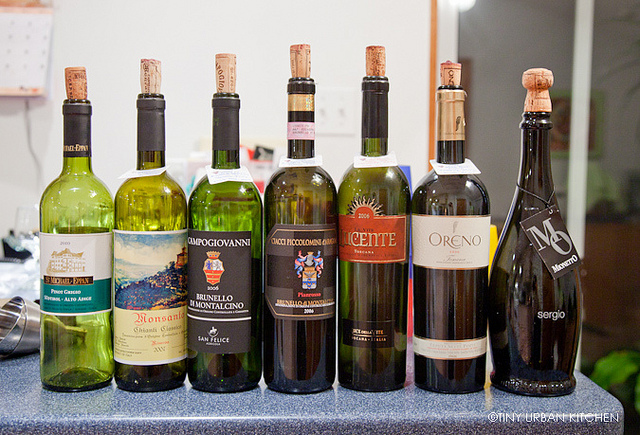
    One of our good friends, Peter (who has guest-posted on this blog before), decided to host an Italian wine tasting event. We started at 4PM and began pairing Italian wines with a variety of Italian dishes for the whole night! (I guess it's best to space out 8 bottles of wine when you have 10 people!). Peter even gave a slide presentation throughout the evening teaching us about the different kinds of wines, regions in which they are made, and grape varieties from which they come. We studied wine tasting notes, aromas, etc. and how they paired with the flavor elements in the food. It was informative, casual, and really fun!

    Of course, I'm sure the excellent wine, delicious food, and good company didn't hurt!


    Here's our menu and pairing!

    FIRST COURSE
    Antipasti elements (marinated mushrooms, olives) and Lobster Ravioli in a Crab Sauce
    2010 St. Michael-Eppan Pinot Grigio (WS 90)
    *tasting note: the acidity of the pinot grigio pairs well with food that take well to acid, such as things on which you would want to squeeze a lemon (e.g., fish, oysters, clams, light pasta)

    SECOND COURSE
    Romano-stuffed Tomatoes (pictured above) and Bolognese pasta (pictured above)
    2007 Castello di Monsanto Chianti Classico Riserva (WS92; 2011 #31)
    2006 Luce La Vite Lucente Toscana IGT (WS 91) 
    *tasting note: the bright acidity of chianti goes well with foods that are slightly acidic, like red pastas.

    THIRD COURSE
    Grilled Lamb Chop and Steak
    2006 Campogiovanni (San Felice) Brunello di Montalcino (WS 96; 2011 #4)
    2006 Ciacci Piccolomini d'Aragona Brunello di Montalcino Vigna di Pianrosso (WS 95)
    *tasting note: Brunellos have velvety tannins balanced by some acidity. These are big wines that are matched with  hearty food such as red meat, flavorful hard cheese, and mushrooms

    FOURTH COURSE
    Beef Shank Osso Bucco
    2006 Tenuta Sette Ponti Oreno Toscana IGT (WS 96; 2008 #15)

    *Tasting note: Super Tuscans are blends that contain non-Italian wines. This particular wine is a blend of Sangiovese, Cabernet, and Merlot. Sangiovese produces a medium-bodied wine high in acidity. Cabernets are full-flavored, fruit-forward, and semi-tannic, thus pair well with red meats. Similarly, Merlots also have deep fruit flavors, with tannic overtones as well.

    FIFTH COURSE
    Beeramisu (tiramisu but made with beer!)
    NV Mionetto Sergio Prosecco 

    NEW YEARS TOAST
    NV Nino Franco Rustico Prosecco


    TOP 10 POSTS of 2012
    In the past two years, I've summarized my "most popular posts of the year" on New Years Day. As my blog has matured over the years, I've found that this year, many of the "top 10" posts are actually old posts that have high search rankings, and thus are still popular. In fact, many of the top 10 posts this year are the same as the top ten last year (thought pretty different from top ten in 2009).

    In order to share some new posts, I've limited this top 10 list to posts that were actually written in 2011. Accordingly . .  .I now present you with the TOP 10 NEW posts written in 2011!

    #10: Copper River Salmon

    I have always loved salmon, but after trying Copper River Salmon, it's hard for me to go back to the bland, overcooked, farm-raised salmon that is so prevalent in grocery stores these days. This salmon has TONS of flavor, and tastes fantastic on the grill (or any other way, in fact!). I partnered with the Copper River Salmon organization in Alaska this summer. It was a great way to try many different types of Copper River Salmon (King, Coho, Sockeye). My favorite is King, which, unfortunately, is only available fresh for about a month and  is also quite expensive!)

    #9: Tomato Vodka Cream Sauce with Bacon

    This is one of my classic go-to recipes when I'm at home during the winter with no fresh produce. It makes great use of canned tomatoes, vodka, and cream (which I often have lying around since I like to make ice cream!). As long as you have some great quality pasta (ideally fresh, but good dried pasta is also fine), you've got a winner of a dish.

    #8: Chinese New Year Recipes

    mustard greens kong xin tsai
    Mustard Greens Sauteed Chinese Watercress
    Spicy Minced Pork with Sour String Beans Chinese chives and Tofu
    Spicy Pork with Sour String Beans Chinese Chives and 5-Spice Tofu

    Chinese New Year is a HUGE holiday in Asia. People take vacation for weeks and travel back to their hometowns to visit family. Of course, the holiday is filled with lots of food. This post essentially provided a nice, graphical interface (filled with pictures) of all the Chinese recipes on this site. I eventually moved it over to the Chinese food gallery so that all could access the recipes more easily.

    #7: Jean Philippe Patisserie

    Last year in Las Vegas I saw the most amazing cakes at Jean Philippe Patisserie inside the Bellagio. This bakery also boasts the largest chocolate fountain in the world! Come check out this post to see other fantastic cakes and also pictures of that crazy fountain.


    #6: Sushi Kanesaka

    I'm always ruined for sushi when I come back to the States after some extended time in Japan. The sushi in Japan is incredible and still so much better than anything I've had in the US (and I've had some pretty good sushi here!).  Sushi Kanesaka was one of the more interesting omakases that we had in Japan, complete with exotic offerings like fish sperm sac! Of course, there were also many, many delicious courses, my favorite of all being the slightly grilled tuna cheek.


    #5: My Favorite Date Restaurants
    Picasso in Las Vegas
    I've had dates in many, many restaurants (Bryan and I eat out a lot). Here are some of my favorite places that do a good job of combining excellent food, great service, and a really nice ambiance.

    #4: Sous Vide Chicken with Pesto
    Chicken pesto
    I got a sous vide machine last fall and have been experimenting with it ever since. I've used it most for steak, actually, though most meats taste pretty amazing when cooked sous vide. Chicken is one of those meats that turns out plump, juicy, and ever so soft (never dry!) when cooked sous vide.

    #3: Oven Roasted Golden Beets
    Roasted golden beets

    I love beets, and I'm surprised it took me so long to realize that beets aren't just deep purple! These diced golden beets caramelize beautifully and taste even better than roasted whole beets (which essentially just steam in the oven). Definitely give them a try if you've never had them before!

    #2: Homemade Oreos (TKO's)


    Oreos are one of my favorite cookies and Bouchon is one of my favorite bakeries. So, it's no surprise that the Thomas Keller Oreo (aka "TKO") is one of my all time favorite bakery items at Bouchon. I was thrilled to find a recipe for these, and I can attest that these are fantastic. I still like the Bouchon ones better (I guess I'm still not that skilled of a baker). However, these are great when I'm getting that itch for a TKO and don't feel like traveling to NYC to get one!

    #1: Meyer Lemon Shortbread Cookies


    I love my Tiny Urban Kitchen stamp! I made these cookies for an annual Boston-based blogger cookie swap last year. It's a simple shortbread recipe but the addition of Meyer lemons adds a gorgeous floral note that I love. These are great as gifts because they pack and store easily!

    That's it! It's been a crazy year filled with lots of travel (Las Vegas, Napa Valley, Tokyo, London, Greece, and NYC), moving to a new house, arrival of my sister's new baby, celebrating my 10th wedding anniversary, and serving and fundraising for the Boston Rescue Mission.

    Here's to an awesome 2012!

    Happy New Year!

    ©2009-2014 Tiny Urban Kitchen
    All Rights Reserved

    Butagumi

    December 27, 2011 by Jennifer Che

    Tonkatsu
    This is part 5 of my latest travel series: Post Quake Japan. Other posts in this series: Kago, Daisan Harumi, Tempura Kondo, and Sushi Mitani.

    In a residential part of Tokyo, far from the hustle and bustle of typical Tokyo life, lies a little whimsical house with a crescent moon cut into the side of it.

    The journey here is idyllic – step off the beaten path, meander through some lovely parks, and emerge in a little neighborhood to discover Butagumi, a restaurant that arguably serves the best tonkatsu in all of Tokyo.
    Butagumi
    What makes Butagumi unique?
    There are many, many well-known tonkatsu restaurants in Tokyo. The most famous one is probably Maisen, a tonkatsu restaurant housed inside of a former WWII bathhouse.

    Unlike Maisen, which sells all sorts of fried items (pork, prawns, potatoes), Butagumi specializes in pork only. The moment you enter the restaurant, you are greeted with a refrigerated display case showcasing many gorgeous cuts of pork.
    pork at Butabumi
    Butagumi is particularly unique because it has an incredibly diverse range of pork selections. Unlike most tonkatsu places, which may offer one or two choices of pork, Butagumi offers over 50 different varieties of pork – everything from the Kagoshima region’s kurobuta (Berkshire pork) to Spain’s highly prized Iberico pork. The selection varies every day, but on any given day you still have several dozens from which to choose.

    Even wall decorations remind you the focus of this special place.

    The menu lists which varieties of pork are available that particular day.  If you really can't decide (and many people cannot), a popular option is to try the "Butagumi-zen" (3000 yen), a tasting plate which allows you to try small portions of 5 different kinds of pork.
    5-piece tonkatsu tasting
    The Butagumi-zen always includes the Iberico pork, which is definitely one of the tastiest (and most expensive) cuts on the menu. If you do order this tasting set, definitely eat the Iberico one last; otherwise, you will be disappointed with anything afterward!

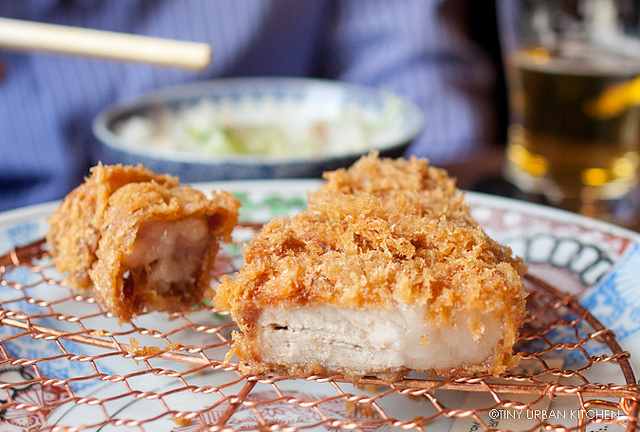
    Although the tasting is fun to get, I still think you should order a whole tonkatsu to get the real experience. The tasting pieces are small and are breaded all the way around. The entire piece becomes less “meaty” and, in my opinion, does not taste as good as a traditional slice of a tonkatsu filet.
    Spanish Iberian Pork Tonkatsu
    If you want to go all out, you can do what Bryan did, which is to get a single order of the Iberico pork tonkatsu (4800 yen). Each order actually comes tagged with a number, likely indicating how many they've sold in the lifetime of the restaurant. Typically, you can choose either a rosu ("roast") or a hire ("fillet") cut. The rosu is pork loin near the lower part of the ribs and is typically juicier and fattier. The hire is tenderloin, and is leaner, but also not as juicy! Usually the staff will recommend rosu since it is juicier and tastier.

    If you're not quite ready to shell out close to $70 for a piece of tonkatsu, you can always get the normal tonkatsu lunch special, which is still good and much more easy on the wallet at 1500 yen. Other possible interesting pork types include Tokyo X, SGP (Super Golden Pork), the Mangalitsa pork from Hungary. For an excellent, in-depth description of many of their pork offerings, check out this post.
    pickles
     Like at all tonkatsu restaurants, Butagumi serves tonkatsu with pickles and shredded cabbage.
    shredded cabbage

    But the pork - how did it taste?
    Oh, of course, how could I forget! The pork was absolutely phenomenal, definitely among the best tonkatsu we have ever had. The Iberico pork tonkatsu was especially delicious – fatty, juicy, and full of flavor.
    tonkatsu
    The crunchy, breaded exterior was perfect – not too greasy yet satisfyingly crispy. If you are a pork aficionado, or if you just really like trying different varieties of pork, Butagumi is an excellent place to visit. The ambiance is comfortable yet quaint; the food is incredible; and the menu offerings are really unique and hard to find anywhere else.

    Butagumi is a little off the beaten track. It sits inside a super cute house that was converted into a restaurant years ago. Enter and walk up the wooden, slightly creaky stairs to the second floor, where, if you’re lucky, you can actually sit next to the crescent window!
    Butagumi

    Butagumi
    2-24-9 Nishi-Azabu
    Minato-ku, Tokyo
    (港区西麻布2-24-9)
    Nearest station: Roppongi

    ©2009-2014 Tiny Urban Kitchen
    All Rights Reserved

    Inakaya

    December 20, 2011 by Jennifer Che


    This is part 5 of my latest travel series: Post Quake Japan. Other posts in this series: Kago, Daisan Harumi, Tempura Kondo, and Sushi Mitani.

    One thing I love about visiting Japan is seeing (and trying!) all the unique aspects of the cuisine that I don't get to appreciate in the States.

    Most Japanese restaurants in America serve a generalized sort of conglomeration of all things Japanese, sort of like a "greatest hits." Sure, you may have a few dedicated sushi bars and ramen joints. By and large however, most Japanese restaurants in the US have diverse menus that include noodle soups, tonkatsu, sushi (and even Korean food sometimes!) all under one roof.

    In past trips to Japan, I've had the luxury of experiencing all sorts of dedicated, specialty restaurants, like shabu shabu, tonkatsu places, countless different sushi bars, ramen joints, dedicated tempura bars, as well as curry houses.

    I really think I've barely scratched the surface when it comes to experiencing all that this amazing country has to offer.

    This past trip to Japan, I encountered yet another, new style of dining I'd never seen before.

    Welcome to Inakaya, a robatayaki located in Roppongi, the most gaijin (foreigner) friendly part of town.

    What is robatayaki?
    Many of you have probably seen teppanyaki restaurants around in the US. These are the ones where a chef cooks your meal tableside on a big, flat cooking serface (teppan literally means metal board). At the ones I’ve visited, the cooking demonstration is typically accompanied by light theatrics, such as fancy chopping with lots ingredients being thrown around (and caught!).

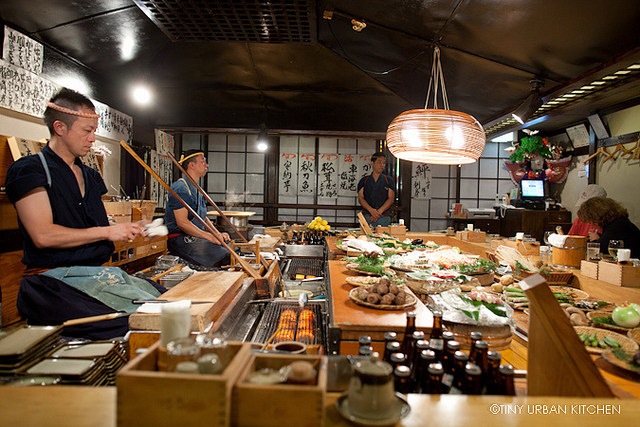
    Robatayaki is completely different. In this style of dining, you have two chefs kneeling on stage in front a huge fire pit. You choose your fresh ingredients, and they roast it over the open flames for you. The ingredients are simple yet high quality, and thus the resulting dishes are really, really good. 


    And then there's the really unique atmosphere.

    The moment you enter, every single worker at the restaurant yells out “Irrashaimase!”

    Though that may be normal at most Japanese restaurants, it doesn't stop there. Soon afterward, a customer orders a beer. Within moments, the server places the cold bottle on a long paddle stick (reminds me of a narrow pizza peel!), reaches across the table to her, and shouts,

    “The lady just ordered a beer!”

    This is followed immediately by a chorus of voices from the entire staff, in unison,

    “The lady just ordered a beer!”

    Of course, this is all in Japanese, which makes it sound all the more comical. It was funny to watch, and made the environment festive and fun.

    Fresh shitake mushrooms
     
    We started with some fantastic vegetables. Nothing was really seasoned heavily – at most a sprinkling of sea salt, maybe some soy sauce, and a brush of vegetable oil. However, the flavors were incredible. The sweet, natural umami of the shitake mushrooms were significantly enhanced by the grilling.

    These gorgeous asparagus were cooked in nothing but a bit of oil and salt, but they were sweet, crispy, and perfectly charred.
     I was really impressed at how good simple fire-grilled vegetables could taste. Above, some little Japanese peppers.

    I was ecstatic to see my beloved matsutake mushrooms again, this time simply roasted with salt. Beautiful. 

    Enoki mushrooms, another favorite, were also wonderful. After gorging myself meal after meal in Japan, this meal felt downright healthy and cleansing, yet still really delicious!

    The fire-roasted seafood was similarly fresh and delicious. These large prawns, cooked in their shells, were sweet and juicy and retained a ton of flavor.

    The pinnacle of the meal, however, was the roasted red snapper, which took quite a long time to cook but was totally worth the wait. Above you can see the chef carefully spearing the fish onto a long, metal skewer.

    The fish probably sat on top of the fire for at least 20 minutes, slowly developing a gorgeous, salted crust. Every so often, the chefs would rotate the fish.

    The final product was incredible. Crispy and salty on the outside, juicy, moist, and sweet on the inside. This was surprisingly simple yet really superb.      
    We ended the meal with some refreshing grapes. Bryan actually said they were the sweetest purple grapes he'd ever had (contrasting with the sour ones with pits we usually have in the the US!)

    Concluding Thoughts
    This place is definitely well-known. It’s written about in multiple guide books and also happens to be located in a very foreigner friendly part of Tokyo (nowhere else do I ever hear so much English spoken on the streets!). While we were there, we noticed only two Japanese diners in the restaurant. Everyone else was a foreigner, with English being the predominantly spoken language.

    Some might think it's a bit staged and theatrical.

    But you know what? It's fun.

    And there are still a lot of reasons to visit. First of all (most importantly!), the food is absolutely delicious. They definitely use super high quality seafood and vegetables. Furthermore, it’s really fun to just sit back, relax, and watch these guys roast anything you want on that awesome grill. The place is foreigner-friendly, so you won’t have any trouble speaking English with the staff. I think it's great for a celebration, a family get-together, or a dinner with out-of-town special guests.

    One thing to note - a meal here is not cheap. Although the a la carte prices aren't too bad, the bill can add up quickly. I think our meal came out to somewhere in the $50-$75 USD range per person, but I've read that you can expect to spend up to $150 USD for dinner.

    Inakaya
    5-3-4 Roppongi
    Imnato-ku Tokyo 

    ©2009-2014 Tiny Urban Kitchen
    All Rights Reserved

    Daisan Harumi

    November 18, 2011 by Jennifer Che


    This is part 2 of my latest travel series: Post Quake Japan. Other posts in this series: Kago

    Wasabi lured Bryan into liking Japanese cuisine.

    Bryan was never a natural fan of Japanese food. Unlike me, who ate it voraciously growing up, Bryan was put off by many traditional Japanese flavors (think bonito, seaweed) and only grudgingly ate it.

    Until he discovered wasabi.

    Bryan has always loved anything spicy - everything from habaneros to horseradish. When he first started eating sushi, he consistently overwhelmed his tiny soy sauce tray with huge dollops of wasabi, mixing in bare minimum drops of soy sauce to form a super thick paste. I seriously doubt he could even tell what fish he was eating (though he totally claims he could). But hey, I was happy we could finally go out to eat Japanese.

    More recently on a trip to Japan, we learned the intricacies about eating sushi and the role wasabi plays. Sushi chefs are quite particular about when to use wasabi, when not to use it, and how much to use. Our palates have gradually become more refined as we've learned the art of appreciating sushi in Japan.
    Daisan Harumi
    With these newly acquired lessons in our heads, our first stop after landing in Japan was (of course) sushi. We made reservations at this tiny 8-seater restaurant in Shimbashi (not too far from the chicken sashimi place!) called Daisan Harumi. Daisan Harumi is super popular on Japanese forums and review sites because of its high quality of sushi and reasonable prices (at least when compared to high end sushi).

    Better yet? They make some fine wasabi. According to the chef (mind you this is in Japanese so I can only hope I understood everything correctly), Hashido-san (one of the chefs) recently won 1st place in a prestigious wasabi contest.

    fresh wasabi root
    There's one thing you might not know about wasabi - "real" Japanese wasabi (wasabia japonica) is difficult to cultivate and very expensive. The roots can cost anywhere from $70 to $100 a pound, and they are in very high demand in Japan. It's also super difficult to find in the US. On this side of the world, "wasabi" is made from a mixture of normal horseradish (less than $1/lb!), mustard, and green food coloring. In Japan, they call this "western" wasabi seiyō wasabi.

    At Daisan Harumi, not only did we get the opportunity to taste "real" wasabi, we had the privilege of watching them make it right in front of our eyes! The sushi chef cuts a portion of the root off, grates it, and then hands you the fresh, bright green paste immediately. You couldn't ask for fresher wasabi than that!
    Kazuo Nagayama
    This was, of course, just the start of a fun and entertaining meal.Meet Chef Kazuo Nagayama, who has been making sushi for over 40 years. He's sort of a Jack of All Trades. He's into pottery, calligraphy, food, and writing, just to name a few. Much of the eclectic dishware at the sushi bar are handmade by Nagayama-san himself. Even the chopsticks wrappers are hand-folded out of traditional Japanese paper.

    The menu changes daily (depending on what's fresh and available), and Chef Nagayama hand writes the menu with a paintbrush on sumi rice paper every day. It takes him over an hour to do this painstaking task, but the result is beautiful. Better yet, he gives you a gorgeous copy (that's also on the same rice paper) to take home with you.
    Cuttlefish

    Chef Nagayama has written various books, including a useful bilingual guide that describes all different types of fish. In fact, whenever we didn't understand the Japanese name for a particular fish, Chef Nagayama or one of his assistant would bring out the correct page from the book and set it on our table.

    Sometimes, as in the case above, he had no book page, so he would have to hand write it. I actually can't read what he wrote - can anyone translate?

    Our meal began with a warm, baked shin ika (young cuttlefish fish) with liver in the middle. It was hot, cooked, and quite fresh, with just a slightly rubbery texture. I'm not a huge fan of liver, so I only thought it was OK. We then had shishamo, the whole fried fish (including the head! - slightly squeamish but I got over it).

    We ordered the omakase (let the chef decide!) with both sashimi and sushi. They always start with sashimi first. In this case (unlike the higher end places which literally give you one piece at a time), Chef Nagayama handed us a plate with various fresh slices - kawahagi with liver sauce (thread sail file fish); aji with ginger sauce (horse mackerel); ika (cuttlefish) and maguro (tuna) with wasabi.
    Katsuo
    The next item was one of my favorite items of the whole night. Nagayama's assistant briefly fired up a gorgeous cut of katsuo (bonito or skipjack tuna) on a skewer. This was insanely good. I loved the interplay between the slightly torched, salted edge and the tender, soft raw center. We dipped the slices first in ponzu sauce and then add lots of wasabi. According to the chef, the fattier the fish, the more wasabi one should add. In this case, since katsuo was a very fatty fish, we should add "many wasabi."

    We had some lovely marinated kohada (gizzard shad) on skewers. These were tender and almost "popped" with juicy-ness when you bit into it.

    These scary looking fried prawn "skins" weirded me out because the eyes were right there! Although it was delicate, crispy, and had a nice shrimp flavor, I was so squeamish that I probably didn't enjoy this as much as I might have had I not known what I was eating!
    Soup
    As the non-sushi part of the omakase came to a close, we had a sour ume (plum) soup (with a tiny shiso leaf and wasabi on top) to cleanse the palate.

    Then the sushi started coming, one piece at a time. Anago (#1 - freshwater eel, also known as conger) was in season at the time. It was smooth,  melt-in-your-mouth soft, slightly sweet, and succulent. Chutoro (#4 - fatty tuna belly) was phenomenal, as always.

    Daisan Harumi is supposedly famous for its amazing mackerel, and this beautiful slice of saba (#2 - mackerel), did not disappoint at all. It was perfectly vinegared, brushed ever-so-slightly with a kiss of soy sauce, and was melt-in-your mouth soft. Kuruma ebi (#3 - Japanese tiger prawn) was pretty good, although I remember telling Bryan that I though the one at Kyubey was much better (ahem, could that be because they freshly kill their shrimp?)

    Abalone was sweet and tender with its characteristic rubbery texture.

    The few times I tried geoduck in America, I did not love it because I thought it had some off flavor I really didn't like. Suprise! The geoduck in Japan (mirugai) was fresh, sweet, and did not have any hints of "off" flavors (upper left photo). The texture was a bit different than fish - a bit more firm, like squid. Shirokisu (Japanese whiting - bottom left) was clean tasting, and the uni (bottom right) was rich and creamy - not a hint of stinkyness.

    Tamago
    Near the end of the meal, they brought out this gorgeous, steaming hot tamago (sweet egg).

    Tamago

    Many think that one can judge how good a sushi restaurant by the quality of its tamago. The tamago here was fluffy, moist, sweet, and just slightly creamy. Although not as refined and delicate as the one at Sushi Kanesaka, it was nonetheless excellent, and I definitely enjoyed every bite of it.
    We ended with a simple gelatin-based dessert that was a nice palate cleanser after such an intense meal!
    Jen Bryan Daisan Harumi Gift
    You get many parting gifts. I already mentioned the handwritten menu and handmade chopsticks wrappers. Nakayama-san also gives all the ladies a pretty furoshiki, a wrapping cloth that can be used to carry your bento, wrap a gift, or even wear as a scarf! Isn't it pretty? 🙂


    Thoughts
    I can see why Daisan Harumi is popular. Chef Nagayama really cares about his craft, and his sushi and sashimi are excellent. My favorites? Definitely the torched katsuo, saba, and toro. There's a bit more liver than I'd personally prefer, so perhaps I would tell him next time if I ordered omakase again. Bryan thought the execution of the sushi was not at the same level as the top, high-end places. Nevertheless, the fish is super fresh; the atmosphere is cozy; and the eclectic touches from Nagayama-san make this restaurant really unique. The prices are quite good for the quality. If you really want a deal, come on Saturdays, when lunch and dinner are priced the same (around 4,000 yen for sashimi, for example). Kawashima-san, Nagayama's longtime assistant, will take good care of you.


    Daisan Harumi
    Nearest Subway Stop: Shimbashi
    Lunch: 6000 - 7000 yen
    Dinner: 15,000-20,000 yen
    Mon-Fri 11:30am-1:30pm, 5:30pm-10:30pm;
    Sat 11:30am-1:30pm, 5:30pm-9:00pm;
    closed Sun
    1-17-7 Shinbashi, Minato-ku, Tokyo

    ©2009-2014 Tiny Urban Kitchen
    All Rights Reserved

    Post Quake Japan

    November 3, 2011 by Jennifer Che


    It has been just shy of eight months since the devastating 8.9 magnitude earthquake and resulting tsunami hit Japan this past spring.

    It was a trying time for all those living in Japan. Many had to bury loved ones, while others are still seeking closure for those that went missing. For millions, the fear of radiation dominated their daily thoughts.

    The world responded with an immense outpouring of love, donating funds, time, and energy.

    However, no one is visiting Japan any longer. Tourism numbers fell drastically after the earthquake. People, scared of the radiation, are afraid to go. It's gotten so bad in fact, the Japan Tourism Agency recently requested one billion yen in funding from the Japanese government to pay for 10,000 free tickets to encourage foreigners to come visit Japan. Nothing's set in stone yet, but there just might be that opportunity come April.

    Bryan visited Tokyo about 2 months after the earthquake. He noticed that the nights in Tokyo were eerily dim as everyone made a conscious effort to conserve electricity.  Recently, Bryan and I returned to Japan. The lights seem to be back, and the city seems to bustle just like before.

    Resilience.

    Well, there is one difference.

    When speaking to one of the most famous sushi chefs in the world, I commented on how surprised I was that I was able to get a last-minute reservation at his tiny 8-seater restaurant (usually notoriously booked out 2-3 months in advance).

    He sighed, looked at me, and said, "the foreigners stopped coming after the quake."

    For some reason that made me so sad.

    Japan is an amazing place, and now is the best time to visit. November is when they enjoy their gorgeous fall foliage. Additionally, if you're a food fanatic, it is surprisingly easy to land typically difficult reservations in Tokyo right now. I called a bunch of these difficult-to-reserve places one week before my arrival date expecting to land maybe ⅓ of them. To my surprise, every single reservation was available.

    This next series will focus on my recent trip to this resilient nation, including some phenomenal restaurants that I never thought I could visit.

    Here's a sneak preview . . .

    The award winning wasabi from this super popular sushi restaurant is hand-grated on the premises right before it's served to you.

    Uni soup? This creative Japanese sushi bar serves incredible, nontraditional starters.
    Chicken breast, gizzard, and liver sashimi? We braved the unknown and tried some exotic Kagoshima cuisine.

    Italian food in Japan still has Japanese twists.
    Really? A two star Michelin tempura restaurant?

    Elegant, whimsical, and intimate dining at a restaurant that seats only three tables a night.
    Hailed by many to be the best tonkatsu place in Tokyo, this place serves 57 varieties of pork, including Spanish Iberico pork tonkatsu.

    Robatayaki - a fun, interactive type meal where everything is roasted on an open flame right in front of you.

    Next week - full details on each of these places!

    ©2009-2014 Tiny Urban Kitchen
    All Rights Reserved

    Snacking in Japan

    April 8, 2011 by Jennifer Che


    It's all my dad's fault.

    Starting from when I was around 2 years old, My dad started me on a tradition. Every day, he would place me in the front basket-seat on his bike and we would visit . . . . . the ice cream shop. I'll never forget the look of that unique ice cream shop in Toledo that was shaped like a huge igloo.

    And thus the habit began.

    I love love love ice cream. In high school I used to eat three scoops a day after school. Even now, whenever I make ice cream, I end up eating it day after day until it's all gone (especially if it's my all time favorite flavor).

    This post is actually not just about ice cream, though it was one of the first "snacks" that caught my eye when I was in Japan. Instead, think of this as a mini tour of my snacking experiences during my trip to Japan.

    Soy Milke Soft Serve at Mr. Bean

    Mr. Bean is a new chain (originally from Singapore, which hails over 50 stores!) that just opened up in Tokyo. This Shibuya location is the first one in Japan. I must admit, I was totally drawn to the super cute bean character smiling at me. Isn't he cute? This stand offers various types of soy milk soft serve, such as plain soy and green tea.

    They also have these cute griddle cakes filled with various sweet or savory fillings -sort of like a conveniently neat sandwich on the go.

    Of course, don't eat while walking! Unlike the Chinese, who are all about street food, the Japanese tend not to eat while walking around. You also can't eat in the trains, so you basically have to find yourself a nice corner to enjoy your snack.

    I loved the fresh and natural soybean flavor of the soft serve. It reminded me of a nice, cold glass of fresh,  homemade soy milk. It was clean tasting, not too sweet, and just really refreshing.

    Sushi for Breakfast in Tsukiji

    Another fun thing to do in Japan is to enjoy sushi in the morning after visiting the fish market in Tsukiji. If you can help it, avoid the weekends, because the lines can get super super long! I've often heard great things about Sushi Bun and Sushi Dai. Unfortunately, the line was about three hours long when we tried to go, so we opted for a smaller, lesser known place with a shorter line.

    At Tsukiji, we saw lots of sea urchin (uni), various grades of tuna (maguro, toro, otoro, chutoro), and lots of salmon roe (ikura). Essentially, you are eating whatever is in season at the time - straight off the boats. Prices aren't too bad - you can get a nice bowl topped with lovely slices of super fresh seafood for around $10-20.

    Streetside Snacks at Asakusa

    One of the most fun places to enjoy more traditional Japanese snacks is on the main street leading up to the temple at Asakusa. Along this admittedly touristy way, dozens of street vendors sell souvenirs as well as snacks. It's fun just to explore and try various things. Most snacks aren't very expensive, and thus you can definitely try several!

    Here's a man baking rice crackers . . .

    A nifty little machine that cranks out little round leaf shaped pancakes filled with red bean paste.

    Takoyaki

    Takoyaki is a savory, octopus-filled cake that is very often sold in little street stands. It's typically served with mayonnaise, takoyaki sauce, and dried bonito flakes. These are especially satisfying on a blustery autumn day since they come out fresh and hot from the griddle.

    Depachika
    One of my favorite things to do when I go to Japan is to explore the vast food-filled basements of the department stores. They are called "depachika", which is a shortened form of "depato" (department store) and "chika" (underground mall). There are countless different types of shops selling everything from raw vegtables to high-end bakery items (like Pierre Hermes!) It's a fun place to try various snacks or grab dinner (although, again, you won't see anyone walking around and eating).

    On our first evening in Japan, Bryan left to attend a business dinner, so I just wandered the basement of Tokyu (a department store) and bought some fun a la carte salads. It was one of the first times I tried to use my rusty Japanese and (thankfully) I was able to communicate. Corn and mizuna salad on the left, lotus root and gobo root salad on the right.

    The supermarkets are filled with beautiful produce. Just the selection of thinly sliced super marbled beef (some of which looked like Kobe!) was mind-boggling.

    Of course the bakery selection is phenomenal - many of Europe's most famous bakeries are represented in these depachikas. Naturally, I visited my favorite and picked up my favorite macaron.
    Jen Ispahan Macaron Tokyo
    I guess I broke the cultural rules and ate my macaron while sitting on a random chair in the hallways of the depachika. Oh well . . .

    Related Posts in this Series

    Tribute to Japan
    Kappabashi-dori
    Tapas Molecular Bar
    Suzuran (Ramen)
    Japanese Matcha and Azuki Breads
    Masamoto Tsukiji Knives
    Maisen
    ©2009-2014 Tiny Urban Kitchen
    All Rights Reserved

    Maisen

    April 5, 2011 by Jennifer Che


    This post is part 6 of my series: Tribute to Japan. Other posts in this series include: Part 1: Kappabashi-dori, Part 2: Tapas Molecular Bar, and Part 3: Suzuran (Ramen)
    Part 4: Japanese Matcha and Azuki Breads, Part 5: Masamoto Tsukiji Knives

    Here in America, it's tough to truly appreciate the nuances and diversity of Japanese cuisine.

    In most parts of the US, all Japanese food is lumped together in one restaurant. Sure, some of you are lucky enough to live in New York, San Francisco, or Los Angeles, where you'll actually see dedicated ramen shops, sushi restaurants, or izakayas.

    For the rest of us, however, "Japanese food" connotes this general idea which is essentially a mish-mash of popular Japanese dishes - spicy tuna rolls, shrimp tempura, noodle soups, a curry dish, and inevitably your chicken or salmon teriyaki bento box. If you're lucky, you might see tonkatsu or its cousin, katsu-don on the menu.

    One thing I love about visiting Japan is the opportunity to learn about (and taste!!) all different types of Japanese food at dedicated, specialty shops. For example, visit the best shabu shabu restaurant in Tokyo, and you'll receive a menu that's literally just full of different shabu items (e.g., Kobe beef . . . sooo good!). Similarly, there are scores of ramen shops, curry houses, and all sorts other shops dedicated to various narrow slices of Japanese cuisine.

    One of my favorites? Tonkatsu.

    Surprised?  Indeed, there are many dedicated tonkatsu restaurants in Japan.

    Tonkatsu is a breaded and deep fried pork cutlet, usually served with a thick, tangy sauce ("Tonkatsu sauce"), shredded cabbage, and miso soup. Inspired by European cuisine, it first appeared in the late 1800's in a Western-food restaurant in Ginza, Tokyo.

    Maisen take-out counter

    These days, Maisen in Tokyo is pretty universally acknowledged as one of the best tonkatsu houses in the city.  Their signature dish is the kurobuta tonkatsu (literally "black pork," also known as Berkshire pork in the US). Kurobuta is known for its high fat content and intense, juicy flavor.

    The restaurant is uniquely situated inside a former World War II public bathhouse. In fact, the main dining room (pictured above) was once the changing room, complete with some of the original architectural details in the high ceilings.

    There's a simple English menu, but we could clearly tell that it only had select items on it. The Japanese language menu is an entire book which, thankfully, has a tons of pictures. Bryan and I both decided to go for the kurobuta set menu, which came at quite the hefty cost (around $35 each! - Grr . . horrible exchange rate!)
    Tonkatsu Maisen
    I still remember asking the server in my broken Japanese, "what's the difference between hire (fillet) and rosu (loin)?"

    She smiled, "rosu has more fat."

    "Which one is better?"

    She smiled, "Definitely rosu."

    We immediately got two orders of kurobuta rosu.

    Wow.

    There's no question - this is seriously by far the BEST tonkatsu I've ever had anywhere in the world. There's really no comparison. The meat is flavorful, tender, and deliciously juicy. The outer panko breaded layer has a nice crunch to it without harboring any hint of greasiness. We first visited this place in 2009 and we made sure to return this time again.

    As part of the set menu, you get a nice, light miso soup (complete with konnyaku!), along with some pickles, shredded cabbage, and rice.

    Finish off with a perfect palate cleanser of citrus sorbet and fruit.

    General Notes
    The restaurant is pretty hard to find. It's hidden behind the Omotesando Hills shopping complex not too far from Harajuku. Thankfully, there are several signs that point you through the meandering backroads which eventually lead to the restaurant. I'd recommend bringing a map or taking a taxi! [In either event, definitely spend some time exploring both Omotesando and nearby Harajuku by foot!}

    We were staying in Shibuya, so we actually walked here.

    Just follow the yellow, circular signs!

    Definitely check out this place if you like tonkatsu. Not only is the food unbelievably delicious, you get to experience a bit of history by dining inside of a WWII public bathhouse. It's conveniently close to Harajuku, Omotesando, and Shibuya, which are must-visit destinations in Tokyo anyway, so why not stop by for a meal while you're there?

    Maisen
    4-8-5 Jingumae
    Shibuya-ku
    Tokyo
    Phone: 03/3470-0071

    Related Posts

    Tribute to Japan
    Kappabashi-dori
    Tapas Molecular Bar
    Suzuran (Ramen)
    Japanese Matcha and Azuki Breads
    Masamoto Tsukiji Knives
    ©2009-2014 Tiny Urban Kitchen
    All Rights Reserved

    Tiny Urban Tidbits #18 - Local News

    March 25, 2011 by Jennifer Che

    _MG_5869
    Kyubey in Tokyo, Japan

    Happy Friday everyone!

    I realize I've been doing a lot of non-local posts lately, so I thought I'd take a tiny break from the Tribute to Japan Series and talk briefly about local things going on around the city.

    If you still want a taste of Japan, you can check out the one crazy post from the November Japan trip that I wrote earlier. In Round 9 of Project Food Blog, we had to write a restaurant review. The stakes were high, as 12 contestants were about to be narrowed down to three!

    I decided to write about Kyubey, one of my favorite sushi restaurants in Japan. The entire meal is simply unforgettable, especially if you've never had a high end sushi experience Japan before. Check out the post here.

    Menton1

    James Beard Award Nominees
    Congratulations to some of my favorite local chefs for their nominations! Cambridge made a strong showing, with Tony Maws (Craigie on Main) nominated for Best Chef Northeast and Will Gilson (Garden at the Cellar) nominated for Best Rising Star Chef.

    Barbara Lynch's Menton has been nominated for Best New Restaurant and Joanne Chang of Flour Bakery + Cafe and Maura Kilpatrick of Oleana have been nominated for Outstanding Pastry Chef. Tim Cushman (O Ya) has also been nominated for Best Chef Northeast.

    Several restaurants I've visited on my travels also made the list. Picasso (where I just went in January) has been nominated for both Outstanding Restaurant as well as Outstanding Wine Service. Richard Reddington from Redd and Josiah Citrin from Melisse are also nominated for Best Chef Pacific. Per Se in NYC has been nominated for Outstanding Service.

    Finally, Gary Danko, who I just met a few weekends ago in Napa Valley, has also been nominated for Outstanding Chef. I would love to try his restaurant one day!

    Congrats to everyone who was nominated!

    New Openings!


    Pinkberry will be opening right in the heart of Harvard Square at the old Alpha Omega Building (sharing that space with a spanking new Starbucks Coffee!). On top of the typical (delicious!) frozen yogurt and toppings, this Pinkberry will also serve breakfast as well as offer Pinkberry Take Home, a 25-oz swirl-to-order tub of your favorite yogurt.

    Floating Rock, well loved Southeast Asian restaurant originally in Revere, has moved to Central Square and will have a soft opening next Friday, April 1. They are currently selling gift cards at a discount. These discounted cards will only be available up until the opening of the restaurant.

    Purchase a gift card worth $25 for $20, a $50 card for $40 and a $100 card for $75. E-mail [email protected] for details.

    Thelonious Monkfish, a new Asian fusion place, has recently opened in Central Square. They have a full sushi menu, as well as plenty of Southeast Asian dishes plus many standard Chinese dishes. I've tried it a couple times and I plan on going again before writing up a full post. Initial thoughts? Some dishes were quite tasty while others were more average. Overall, I think it's a great addition to the area. Central Square can really benefit from a place like this.
    Rialto

    EmPower Breakfast at Rialto with Jody Adams!
    EmPOWER Breakfast is an annual benefit in collaboration with women from the business community to raise much needed funds for Asian women and children impacted by domestic violence.

    This year, the event will be Thursday, April 7 from 8AM -10AM at Rialto. There will be breakfast, a silent auction, and a panel discussion. I'll be there blogging about the event as well!

    To find out more and to purchase tickets, please visit this page.

    This event will be hosted by Jody Adams (Chef/Owner of Rialto Cambridge), Vivian Hsu (Principal of Hsu & Associates, LLC) Renee Inomata (Partner at Burns & Levinson, LLC) and Janet Wu (7News/CW56).

    Pop Up Restaurant!

    They've struck again! It's yet another pop up restaurant! As many of you know, I went to my first pop up restaurant at the Taza Chocolate Factory.

    This time, Aaron Cohen and Will Gilson (along with Sel de la Terre chef Louie Dibiccari) will set up a pop up restaurant at Mizu hair salon on Saturday, April 9, 2011. A 5-course menu will costs $100 and includes tax and gratuity. A portion of the proceeds will be donated to the International Medical Corps to aid Japan.

    To learn more and to buy tickets, click here.

    That's it folks! Have a wonderful weekend, and we will continue the Tribute to Japan Series next week!

    ©2009-2014 Tiny Urban Kitchen
    All Rights Reserved

    A Tribute to Japan

    March 23, 2011 by Jennifer Che

    I have always loved Japan.

    As a child, I was exposed to a bit of Japanese culture because my parents were Taiwanese. Taiwan was occupied by Japan for 50 years (between 1895 and 1945), and thus my grandparents lived under Japanese rule for a large part of their lives. Inevitably, they absorbed various aspects of Japanese culture. In fact, my maternal grandparents felt more comfortable speaking Japanese than Taiwanese or Chinese with their kids.

    As a college student, I decided I wanted to learn more about Japan. I studied the language for two years before spending a summer interning at Hitachi Chemical. I absolutely loved living there. One of my favorite things to do was to roam the immaculate and beautiful supermarkets after work, picking out my dinner for the evening.

    Of course, it's not just about the food. I also loved the people that I met. Even after leaving Japan, I continued to hone my language skills, building long lasting relationships with Japanese friends through language exchange partnerships.

    The news of the recent earthquakes and aftermath in Japan is downright devastating. My few friends who live in Japan are in Tokyo, so they are safe, although extremely frightened. My heart continues to ache for those who have suffered great losses, and I pray for them.

    The Japanese are quite resilient, and I am confident they will rebuild, recover, and come out stronger in the end. As a tribute to them, please join me as I begin a series dedicated to Japan: a celebration of their unique culture, rich history, and (of course) amazing cuisine.

    Sneak preview ahead . . .


    Bryan and I had the privilege of visiting Japan this past November. Bryan had a business trip there, so I just came along for the ride. We stayed in Shibuya, a bustling area with one of the most famous and crazy crosswalks in Tokyo.

    The view from our hotel on top at Cerulean Towers

    I always get one of these whenever I come to Japan!

    You gotta love the plush version!

    Of course we had to stop by Domo-kun's home - NHK Studio Park!


    You can get your favorite characters in all different sorts of colors.

    Or Hello Kitty wearing all different sort of "suits." (yes, this is borderline disturbing)


    Or if you prefer kitchenware, visit this super fun neighborhood in Japan devoted to restaurant supplies, fake plastic foods, and other fun kitchen gadgets. It's where I got my cookie stamps!

    Or stop by Tsukiji fish market to get some seriously quality (and expensive!) knives.


    The food in Tokyo is among the best in the world. Here, we visited one of Tokyo's most famous molecular gastronomy restaurants (1 Michelin Star)

    One of our favorite ramen places with handmade noodles, of course!

    Kurobuta Pork tonkatsu at a former bath house.

    Street food! Do you know what these are?

    Everything I learned about sushi I learned from my mom  . . . and this place.


    Probably the best sushi I've ever had in my life at this 2-star Michelin unassuming sushi bar.

    Cherry Blossoms at Shinjuku Gyoen

    ©2009-2014 Tiny Urban Kitchen
    All Rights Reserved

    Tiny Urban Tidbits #17 - Bryan Tries Puffer Fish!

    March 4, 2011 by Jennifer Che


    How many of you have seen that famous Simpson's episode where Homer tries puffer fish?

    I think for most of us, puffer fish is something that's exotic, far away, and not really something you would expect to see ever on a US menu.

    On Sunday we visited one of my favorite Japanese restaurants in Boston, Oishii. Bryan saw fugu on the specials menu and really really wanted to try it. Fugu is the infamous puffer fish. It contains a lethal poison, tetrododoxin, which must be carefully removed before consumption. In Japan, fugu preparation is controlled by law and only licensed chefs (who train for 2-3 years!) can prepare and sell the fish.

    Rumor has it that your lips "tingle" a bit when you taste it, allegedly from the tiny bit of residual poison. The poison works by paralyzing your muscles. Most victims die of asphyxiation.

    And Bryan really wanted to try it???!!
    Oishii Boston sushi bar
    Don't ask me why, but the risk of this dish is a large part of the draw of this weirdly exotic dish.True thrill seekers will actually flirt with death (and the law!!) by eating the liver, the most poisonous part of the puffer fish.

    I continuously snapped pictures as Bryan tried his first bite.

    One bite.

    Chew chew . . . pause . . . . funny expression.

    "It definitely tastes like a cross between lobster and squid sashimi. And there is a slight tingle."

    Swallow. More pauses.

    I think he's going to be OK.

    Phew! OK . . on to dessert!

    Valentine's Dessert at Oishii

    In reality, these days the risk of dying from eating fugu is pretty low. In fact, between 1993 and 2006, only 23 incidents were reported, with only one occurring at a restaurant. All the others involved fisherman eating their catch.

    Furthermore, the biggest risk is eating the liver (now illegal in Japan!), the ovaries, or the skin (not as much risk with the flesh).

    Nevertheless, there's still this slight sense of fear and excitement at the same time when you're trying something like fugu for the first time!

    Fugu

    Valentine's Day
    Though we eat out often, we actually chose to stay home on Valentine's Day proper. I seared a simple, sous vide prime steak and we paired it with some fresh pasta tossed with a little bit of butter, cream, and thinly sliced black truffles.
     
    Simple, elegant, and totally relaxing.

    What's up next?
    Next week we wrap up the Las Vegas Series (three more restaurants, including the best steak Bryan's ever had in his life, Two-Michelin Stars, and a really famous chef from LA). After that? Look out for posts on some of Boston's most well-known burgers, several more giveaways, and a Tokyo Series!

    Have a wonderful weekend! 

    ©2009-2014 Tiny Urban Kitchen
    All Rights Reserved

    A Pizza Tour of My Travels

    October 17, 2010 by Jennifer Che

    PizzaCollage-1
    My family has always loved traveling. Even though my parents were incredible frugal with everything else, we somehow always could afford plane tickets to fly to various parts of the world. Heck, my paternal grandfather founded what became the largest travel agency in Taiwan. When you have something like that in your lineage, you know you're destined to travel.

    To this day, the travel bug has never left me, and I'm always wondering what trip to take next.

    The next round in Project Food Blog is to create our own interpretation of pizza. I decided to take this opportunity to reflect upon the last decade or so of travel and express those trips by creating the flags of the countries I have visited as pizzas.

    Now mind you, I do mostly Asian cooking (although Bryan does have an affinity for fresh pasta, so I do make lots of various pasta dishes). Nevertheless, I have never ever made pizza before.
    stretching pizza dough'
    Pizza dough is easy enough to make, ha ha, if you have a bread machine, which I do.

    Pizza Dough
    ¾ cup warm water
    1 T olive oil
    2 ¼ cup all purpose flour
    1 teaspoon salt
    1 teaspoon sugar

    1 teaspoon dry yeast

    Just throw in water, oil, flour, salt, sugar, and yeast into the machine (in that order), set the machine to "dough only cycle," and before you know it, out pops some pizza dough. Of course, you can also purchase pizza dough, either from the supermarket or your favorite pizzeria. You'd be surprised to learn that they are often willing to sell the dough for a very reasonable price.
    IMG_3620-1
    Silly me, I thought you had to toss the pizza dough and magically stretch it in this laborious way.
    IMG_3720-7
    So Not true. Rolling out with a rolling pin works just fine.
    IMG_3721-8
    In fact, it's a lot easier to control the shape of the pizza dough that way, which was important for me, since I needed rectangles for my flags.
    IMG_3622-2
    You don't need a pizza stone, but it really makes the pizza taste so much better. It's best to heat the pizza stone in the oven for about 30 minutes at 450 to 500 °F before putting the pizzas onto the stone. After that, bake for about 10-12 minutes.

    It's really surprisingly simple. And you can totally use your creativity for the toppings - heh, just like the way I did in creating these pizzas. I tried my best to incorporate bits of each country's actual cuisine into the pizzas (in some cases easier than others).

    Sooooo . . . without any further adieu, allow me to take you on a short, virtual tour of my travels in the form of pizza flags!

    Canada
    IMG_3641-5
    I grew up about an hour's drive from Windsor, Canada, so my family went there frequently to shop for Asian groceries and eat good Chinese dim sum. However, my most memorable trip to Canada was a family trip to the Canadian Rockies in 1998. This is seriously one of the most beautiful places I have ever visited. The scenery is breathtaking, especially the soaring mountains and the unusually turquoise water.
    jen-canada-rockies-final-1
    Canadian Rockies, Canada

    This pizza takes an ordinary pepperoni pizza and jazzes it up by caramelizing the maple-leaf shaped pepperonis with maple syrup in a toaster oven. The red sauce on the side is a simple tomato, butter, and onion sauce. Feel free to use your favorite tomato sauce recipe.
    MakingCanadaPizza-1
    The United Kingdom
    IMG_3734-1
    I visited London for the first time back in 1999 when my college a cappella group went to work with a Chinese church in London for a week. I have fond memories exchanging cultural ideas with those Chinese Christians in London.
    20080511-IMG_0028-1

    This pizza is a play on "Bangers and Mash," a British dish I learned about during that trip. The pizza sits on base of purple mashed potatoes ("mash"), and has strips of sausage ("bangers") as the red stripes. Thinly sliced mozarella cheese act as the white part of the flag.
    PurpleMashBangers-1

    Italy
    IMG_3646-1
    Bryan and I spent our honeymoon in Rome, Venice, and Florence. We enjoyed absolutely fantastic food in Italy, and learned how good, fresh ingredients can really make simple dishes shine. This pizza is inspired by the classic Italian salad Insalate Caprese (tomato, basil, and fresh mozarella). In this case, instead of using basil, I have added peppercress, a pungent and fragrant green that adds a lovely bite to the pizza.
    VeniceRoofDeck
    A rooftop champagne toast in Venice, Italy

    France
    IMG_3634-4
    I studied French in high school and have always loved the beautiful language. For a special milestone birthday, Bryan and I spent a week in Paris, staying right on the grounds of Versaille. It was in Paris where I first discovered my love for the Pierre Hermes Ispahan macaron. 
    _MG_0997-1
    This simple French flag pizza comprises fresh tomato slices, fresh mozzarella cheese, and mashed blue potatoes. The flavors are simple yet delicious when you use high quality, fresh ingredients. For a taste of France, you can incorporate a strong blue cheese into the mashed potatoes for a more unique flavor.
    _MG_0655-1
    Versaille, France

    USA
    IMG_3743-3
    Bryan’s family loves to camp at national parks, and I’ve had the wonderful opportunity of seeing some of these beautiful parks with his family ever since we got married.

    IMG_9776-1
    Capitol Reef, Utah

    This USA flag contains blue potato slices, mozzarella cheese, and a simple red tomato sauce. The stars are sprinklings of feta cheese. For an alternative way, you can use a base of mozarella cheese and then make the red stripes using bacon.
    IMG_3611-1

    Japan

    IMG_3741-1
    I studied Japanese in college and spent a summer working as an intern right outside of Tokyo. I fell in love with the food and culture of Japan while I was there. However, it wasn’t until 10 years later that I had the chance to return, this time with Bryan. Bryan and I enjoyed incredible food in Japan (fresh sushi and Kobe beef, just to name a few). This rice-based pizza is inspired by the sushi that we had in Japan. Prebake a "crust" by baking a square of dough without any toppings. After the crust is done, top with sushi rice and sushi-quality raw tuna (maguro). Optionally, put a dab of wasabi right underneath the tuna (out of sight).

    _MG_0470-1
    Kyubei in Tokyo (my favorite sushi place!)

    Taiwan
    IMG_3742-2
    Of course, my parents are from Taiwan, so I went to Taiwan frequently as a child. My favorite foods in Taiwan? Traditional Taiwanese breakfast, shaved ice, and dumplings! I gave this pizza an Asian twist by blending roasted red peppers and “spiking” the mixture with Sriracha sauce to create a spicy and sweet base sauce. The blue portion is mashed blue potatoes, and the “sun” is a sliced mushroom. 
    IMG_0146-1
    Ice Monster, Taipei Taiwan

    So that's it! I have hardly touched every country I've visited, but at least I've taken you to visit some of them, albeit brief! Thank you so much for joining me on this journey around the world in the form of pizzas!

    Bon Appetit!
    IMG_3746-1
    Thank you so much for those of you who voted for me the last several rounds. This blog entry is my submission for The Next Food Blog Star’s fifth challenge: Pizza! If you are so inclined, please vote for this entry. Thanks so much for your support!

    ©2009-2014 Tiny Urban Kitchen
    All Rights Reserved

    Tiny Urban Tidbits #5 - My Astronaut Husband

    May 21, 2010 by Jennifer Che

    Space Ship
    There's a term in Chinese used to describe businessmen whose families live in the US but who have businesses in Asia, and thus are always flying back and forth. Tai kong ren is a play on words because it sounds both like the word for "astronaut" but also sounds like the words for "No wife" man.

    I sometimes feel like I'm married to one of those "astronauts." Bryan travels a lot for work, and most of it involves airplanes.  In fact, my astronaut reached a big milestone last week.
    Million Miler

    That's right. He became a million miler on American Airlines. No, he did not get to talk to the pilot, nor did he receive a special black card with his name on it.  They did, however, announce it during the monumental flight.

    There are some perks to "being yoked to Executive Platinum" (as my friend likes to put it). He has so many miles that you can both fly to Asia for free, First Class.
    First Class Dining AA
    In First Class you get 2 seats: one for you, one for your Totoro.
    First Class AA
    But of course, you pay the price by having him away from home, a lot.

    I've decided to dedicate this post to Bryan in celebration of his Million Miles.

    Bryan often will take food photos for me on his many trips. Join me as we take a brief culinary tour around the world, experiencing all different kinds of cuisines from the various continents that Bryan has visited.
    IsraelSweets

    An assortment of desserts from Israel.Peking Duck

    Peking Duck from Beijing, China.
    Xiao Long Bao from Shanghai
    Xiao Long Bao (Soup Dumplings) from Shanghai, China.
    Sichuan Meal in China
    A fiery hot Sichuan meal from China.
    Chinese meal
    A Chinese Family Style FEAST from Taipei, Taiwan.
    Sushi in Japan
    Fresh sushi from Tokyo, Japan.
    Korean BBQ in Korea
    Korean BBQ from Seoul, Korea.
    Ramen in Hong Kong
    A hot bowl of ramen from Hong Kong.
    Ham, Toast, and a Poached Egg in Australia
    Ham, bacon, and a poached egg on top of toast from Sydney, Australia.
    Gourmet Burger Kitchen in London
    A burger from Gourmet Burger Kitchen in London, UK. [heh, I actually took this picture because I went with him to London during his business trip]
    Momofuku Pork Belly Buns
    Momofuku Pork Belly Bun from New York City, USA.
    Bryan Travels
    The World Traveler himself.

    Hope you enjoyed the tour. Someday I may post more pictures and write detailed posts for some of them. Until then, enjoy these pictures! Have a great weekend.

    ©2009-2014 Tiny Urban Kitchen
    All Rights Reserved

    Morimoto

    April 15, 2010 by Jennifer Che

    Morimoto-1

    Masaharu Morimoto.

    An original Iron Chef from the hit Japanese show.  Trained in Hiroshima, both as a sushi chef and also as a kaiseki expert (fancy Japanese multi-course set menu experience).  Worked as the head chef at Nobu before opening his own restaurant, Morimoto, in Philadelphia in 2001.  And in 2006, opened a second one in New York, right in the Chelsea Market building (which, by the way, is a destination in and of itself for any food enthusiast who loves to explore interesting food markets).

    Of course, we opted for the omakase ($120), the best way to experience this Iron Chef's creative energy.
    Morimoto Sushi bar
    Upstairs you have the massive sushi bar that wraps around on three sides.  Sushi is flown in four times a week from Tsukiji Fish Market, the largest fish market in Tokyo.
    Morimoto bar
    Downstairs you have the cool swanky bar.  At 7pm (which is when we arrived) the bar was relatively empty.  Within an hour or so, the place was bustling, crowded, full of people chilling on a Saturday night.
    Morimoto beer
    Morimoto has partnered with Rogue Ales in Oregon to produce a line of beers.  This hazelnut beer was actually really good!

    The Omakase (Chef's Tasting Menu)
    You'll have to forgive me for not knowing the names of everything I had.  As this is a chef's tasting menu, nothing is written down. I'm basing this from memory, which is shady at best.

    Enjoy!
    Toro
    We started out with a beautiful toro tartare and osetra caviar creatively spread out inside a small, flat wooden box.  On the bottom, several sauces with which to experiment: wasabi, sour cream, nori paste, chives, avocado, and natto? (I can't remember the last one).  I love toro, and therefore it was not difficult to absolutely love this starter.
    Morimoto
    Whitefish carpaccio tossed in a light, soy-sauce based vinaigrette.
    hamachi
    Yellowtail Pastrami with almond foam and microgreens.
    salmon ravioli
    House-smoked Salmon "ravioli" with salmon roe, Japanese sweet yams, and yuzu foam (I got this one).
    fois gras and oyster
    Kumamoto oysters and fois gras and uni (sea urchin) (Bryan got this one).  This dish was amazing and had a beautiful mix of flavors. Both Bryan and I agreed that this dish tasted a lot better than my smoked salmon ravioli.
    Sushi
    Assorted Sushi: I actually thought the sushi was only OK.  It might be because I did not love the particular pieces they brought out.  Personally, I much prefer the sushi both at Sushi Yasuda and Kyubei.
    Morimoto: cooked fish
    Free random appetizer The service was actually really slow the night we went - we were there for over three hours, and we only had 7 courses.  That translates to ½ hour a course!  At the end of our meal, the waitress even admitted that the kitchen was a bit "off" that night.  The above dish is something I think we got by mistake. It's just a little appetizer of mushrooms and cooked fish.  I actually thought it was pretty average (the fish was really hard - like overcooked swordfish!).  Oh well, it was free, I guess, but it lowered my opinion of the kitchen just a notch.
    Morimoto: Surf and Turf
    Bryan's main course was pretty good.  Bryan got the "Surf and Turf" - Kobe beef and lobster.  This is actual Kobe beef (not wagyu) from Japan. Bryan thought that everything was perfectly cooked.  Of course, how can you go wrong with Kobe? (Kobe is an optional add-on to the normal omakase and costs extra.  Typically, it comes with normal beef)
    MorimotoBibimbop-1
    I asked for something lighter for my main course (I really did not feel like eating steak), and they gave me this Ishi yaki buri bop (yellowtail bi bim bop) cooked tableside in a hot stone bowl.  When the dish first arrived I was really excited because of the beautiful raw slices of yellowtail (see top left picture).  Then the waiter started stirring everything around in the super hot stone bowl (top right).  Internally I kept thinking "Nooooo!!! Don't cook the fish!"  Alas, he finished mixing and presented my final dish to me (bottom).  **Sigh** the beautiful yellowtail was now clearly cooked all the way through.  The dish was still enjoyable, but I'm sure I would have enjoyed it more had the fish been raw.
    _MG_3242-10
    We both ended with a nice, triple chocolate dessert.  I remember liking it, although I can't remember any particular details about it except that I enjoyed the interplay of textures between the creamy cold ice cream (or sorbet?) and the crunchy cookie below.

    Overall thoughts?
    Overall, Morimoto is worth visiting, at least once. The space, which cost $12 million to build, is a sight in itself. The food is inventive, beautifully presented, and, for the most part, pretty enjoyable - there are definitely some standout dishes. There's no doubt that the seafood is fresh and top notch.  I loved the raw fish portions of the tasting menu.  My favorites?  The toro tartare, the yellowtail pastrami, and the oyster and fois gras (amazing!).  It's not all perfect, though.  As I mentioned earlier, the timing of the kitchen was pretty off, and we often waited long stretches between courses. Also, some of the dishes, such as the ravioli and the mushroom/fish appetizer, were quite average.  Honestly, if you only have a few days in New York, there are probably a lot of other places I would pick over this one.  If I came back, I would likely skip the omakase and just order the dishes that I think I would love (e.g, raw fish appetizers like my first three courses!)

    Other posts in this Big Apple Series
    Per Se
    Morimoto
    Joe's Shanghai
    Waldorf Astoria
    Smorgas Chef

    Morimoto
    Chelsea
    88 10th Ave
    New York, NY 10011
    Morimoto on Urbanspoon

    ©2009-2014 Tiny Urban Kitchen
    All Rights Reserved

    A California Christmas

    January 4, 2010 by Jennifer Che

    This begins yet another mini-series on delicious eats of Southern California.

    Being married to a California native, I have the benefit of getting away from the cold weather in Boston every Christmas to enjoy the bright and warm sunshine, the amazing Asian food, and the great shopping that Southern California has to offer - not to mention the priceless company of family and friends.

    With respect to food (this is a food blog, after all), this past trip I enjoyed some old favorites and also some amazing new places.  Everything from casual Taiwanese street food to the highest Michelin rated restaurant in Southern California.  Stay tuned this week for detailed descriptions, impressions, and of course, plenty of photos!

    Here is a peek at what is to come!

    XiaoLongBao

    Soup dumplings from my favorite dumpling restaurant in the world. Will the Southern California outpost match up to the original restaurant in Taiwan?
    _1000785
    Deliciously chewy boba matched with high quality tea - this tea place in Cerritos is our favorite place to hang out late at night.
    _1000775
    Probably the best sushi in Little Tokyo and arguably among the best sushi in LA - how would this compare to our favorite places in NYC and Tokyo?
    Cavier Egg
    A signature dishes from one of the most highly rated restaurants in Los Angeles. How will it compare to the other two Michelin rated restaurants we've tried in New York?

    UPDATE: Here are the posts related to this series:
     Part I: Ten Ren Tea Station
    Part II: Din Tai Fung
    Part III: Sushi Gen
    Part IV: Mrs. Knott's Chicken Restaurant
    Part V: Melisse

    ©2009-2014 Tiny Urban Kitchen
    All Rights Reserved

    Southern California Favorites

    May 14, 2009 by Jennifer Che

    A friend of mine is going to California for a wedding and asked me for food recommendations in Southern California. We go to California at least once a year since Bryan is a native Californian. However, most of our eating is centered in Orange County, since that is where his family lives.I don't claim to be anywhere close to an expert on Southern California's best eats. However, I would like to share with you some of our favorite places. I can attest that these places are excellent. Peking Restaurant
    8566 Westminster Blvd
    Westminster, CA
    6794309178_503638c31d_z.jpg
    Excellent Northern style Chinese food - I would definitely order the homemade noodles, the niu ro jia bing (beef slices rolled in a scallion pancake with hoisin sauce and cilantro - incredible! -- see picture above), pan fried dumplings, and boiled dumplings. It's cheap, delicious, and totally authentic. Be prepared to wait if you go on a weekend during lunch.Ding Tai Fung
    1108 South Baldwin Avenue
    Arcadia,California
    91007
    4229972504_aaa237af31_o.jpg
    If you read this blog, you probably know that this is one of my all time favorite restaurants. Even though it's a 45 minute drive from Bryan's home, we drive there almost every time we are in California. My favorites are the vegetable pork dumplings and the soup dumplings. Be prepared to wait no matter when you go. The last time we went, they had expanded and had taken over another space within walking distance of the original restaurant. We went to this other space and didn't have to wait.

    Sushi Gen

    422 E 2nd St (Little Tokyo)
    Los Angeles, CA
    I actually have not been to this restaurant in Little Tokyo, but it's widely regarded as one of the best and freshest sushi places for a reasonable price. My mom told me that all the Taiwanese people know about this place. I definitely want to try it the next time I go to LA!

    In & Out
    All over Southern California
    This hamburger place is classic - with everything made from scratch and to order. Order off the "sceret" menu by asking for a "two by two" burger (2 patties / 2 buns) and "animal style" (with grilled onions and special sauce). I really love the burgers here, and the prices are cheap too.

    Tea Station

    _1000788

    11688 South St #101
    Artesia, CA 90701

    (562) 860-7089


    This tea shop totally reminds me of Taiwan. Not only does it serve excellent tea (Ten Ren brand plus many others), it serves a host of Taiwanese late night eats, such as noodle soups, tea eggs, popcorn chicken, tofu, and Taiwanese sausages. The ambiance is relaxed, friendly, and nice. When we were in California, we came here almost every night to sip tea, enjoy snacks, and play board games.

    Happy Nest (Formerly Little Bean)

    18902 Norwalk Blvd
    Artesia, CA 90701

    (562) 860-8843

    This is also another fun Taiwanese place that serves shaved ice, boba tea, and Taiwanese snacks, similar to Tea Station. The store is brightly lit with fluorescent lights. I have not been here too many times, so unfortunately I can't comment as extensively on the menu. Everything I've had there has been good, and it appears to get excellent reviews on various food sites.

    Above I've listed our favorite haunts. We've tried other restaurants only once, such as celebrity chef Tom Colicchio's Craft or various other ethnic restaurants (e.g., Peruvian, Italian, Szechuan, and Japanese places). However, we are really not that familiar with the LA foodie scene. I would welcome other suggestions for great places to eat so I can try them the next time we are out there!

    ©2009-2014 Tiny Urban Kitchen
    All Rights Reserved

    Cafe Mami

    August 20, 2007 by Jennifer Che

    Porter Square is the closest thing that Boston has to a Japantown. A single building on Mass Ave houses a Japanese grocery store (Kotobukiya), a Japanese gift shop, a Japanese costume shop, a Japanese bakery, a boba tea shop, a sit-down sushi restaurant (Bluefin), and several casual food stalls specializing in various sorts of Japanese food (curry, ramen, and sushi, just to name a few).

    We tried Cafe Mami on Friday night. Cafe Mami is tiny - it has a bar area that seats about 4 people and then two larger tables that fit 4-6 people each. That's it. Oftentimes, they will seat two parties at each of the tables.

    The food at Cafe Mami was cheap and good. For a mere $8, you get a salad, miso soup, and an entree. Cafe Mami specializes in rice dishes, and sells familiar dishes such as katsudon, yakidon, and curry.

    Bryan ordered the curry with beef and a fried egg on top (sunny side up) and I ordered the yakidon. Yakidon is a soy-based marinated beef that slightly reminds me of Korean BBQ. I thought the flavor of my yakidon was perfect - both sweet and salty in a perfect way that makes the dish horribly addictive. In fact, the flavor of my dish was so addictive that I ended up eating more than I had planned (in other words, I finished the entire dish).

    Bryan's curry was also yummy. Accordingly to our friends, who go there often, the hamburger curry with the special tomato sauce is really good. The deep fried chicken tenders are also supposed to be amazing. The place really feels authentic, like you're sitting in a little Japanese food stall in Tokyo.

    Apparently the place is very popular and it's often difficult to score seating. I guess we were lucky - we arrived early on a Friday night (around 6:15 PM) and didn't have to wait for a seat.

    Over all, I thought this place was great. If you're in Porter Square, check this place out for yummy, satisfying, home-cooked and cheap Japanese food. YUM.
    Cafe Mami on Urbanspoon

    ©2009-2014 Tiny Urban Kitchen
    All Rights Reserved

    About me

    January 1, 2007 by Jennifer Che

    Kyaraben
    Who is Tiny Urban Kitchen?

    Hi! My name's Jen.

    Tiny Urban Kitchen was born out of my tiny urban condo situated between my alma mater and the other school in Cambridge. My tiny urban condo came with a tiny urban kitchen, hence the name of this blog. It was bit tight at times, but over all, it worked for me, and I spent lots of time there exploring new recipes and cooking methods.

    I then moved out of that condo into a medium urban townhouse in Cambridge. My kitchen had a bit more space. In September of 2017, I moved to Hong Kong, a land known for its tiny, tiny apartments (they even call them "nano" or "micro" flats). In many ways, I've moved back to the roots of this blog, back to a true "tiny urban kitchen."

    I am an experimenter by nature. I worked as a research chemist for years synthesizing new molecules in the lab. At home, I am always trying new things in the kitchen, exploring fun, new creative ways to cook.

    I also love eating, and am very willing to travel for good food! That's why this blog also includes my takes on my various eating adventures around the world. I love sharing about my food adventures, and I also love hearing what you have to say. So, please leave a comment, say hello, and feel free to give me your thoughts and suggestions too. If this is your first time here, welcome!

    If you're interested in cooking, definitely check out the Recipes link, which is a compilation of all the recipes on the site to date. If you like Asian food, visit the Chinese Recipes Gallery, which gives you a quick, photolicious way of browsing through the Chinese recipes on the site.  For dining out, a great way to start is top restaurants to visit in Boston, posts from other US cities, or food from my worldwide travels.

    Interested in the sous vide technique? Here's a primer on sous vide, including links to several recipes I’ve made from famous chefs like Thomas Keller and David Chang. 

    How did Tiny Urban Kitchen get Started?
    Check out my entry for round 1 of Project Food Blog which describes not only how this blog began, but really the core of what motivates me and what defines Tiny Urban Kitchen.

    Dining Out 
    Since I lived in Cambridge for over 20 years, many of the restaurants on this site are in the Cambridge/Boston area. The best way to search my neighborhoods is to hover over the Travel/Restaurants tab at the top of the blog menu, go to US, Boston, and then pick the neighborhood. You can navigate the entire blog that way.

    For a fun photo gallery of all the Michelin Starred restaurants I visited, check out the Michelin Stars Gallery. I do travel extensively, and thus you’ll find all sorts of food from places such as New York City, Las Vegas, and Napa/Sonoma in the US, tons of places in Asia (Tokyo, China, Taiwan, Malaysia, Singapore, Thailand, and of course, Hong Kong), as well as several countries in Europe.

    I've written up a few travel guides for cities that I know better. Feel free to check them out here.

    What has surprised you most about food blogging? 
    I think everyone says the same thing, and I have to agree. The community is AWESOME. Most people start food blogging to share recipes with friends and family, or to keep a record of all the restaurants they've visited - at least that's why I started my blog. You never really realize how food blogging can connect you to so many like-minded people around the world. I've had the great privilege to "meet" people from Europe, Asia, Australia, Canada, and, of course, all over the US. Things like the Foodbuzz Festival are great ways to connect with other food lovers. I never would have thought that starting a food blog would open the door to so many other friendships, opportunities, and experiences.   

    What has been the most amazing food opportunity that you've had as a result of food blogging? 
    No question it would be my trips to Napa Valley (both in 2010 and in 2011) to Napa Valley to blog about the S. Pellegrino Almost Famous Chef Competition. In 2010, Foodbuzz and S. Pellegrino had hosted a contest to send one person there. I was thrilled and beyond belief that I had actually won the contest. The trip really opened my eyes to what the food industry is like. The food industry, especially the restaurant industry, is grueling, and it takes a ton of hard work and perseverance to make it. I was so privileged to be able to see this up close. It really gave me a new perspective and added respect for those who choose to follow this career path. Of course, Napa Valley is also beautiful, and I had a fabulous time there just checking out the vineyards and trying some amazing restaurants! 

    What camera do you use? What's your process in photography? 

    I switched between my Sony Cybershot DSC RX1R, (which is more pocket-sized so I carry it around with me everywhere I go) and my Canon 5D MKIII depending on the situation.  The SLR is really big and heavy, so I use it more during vacations and food events that are clearly "camera-friendly." I would say 80% of the pictures on my blog are taken with the pocket sized cameras. I use Adobe Photoshop Lightroom CC to catalog and work up my images, which are all shot in raw format. I then export them to the blog on WordPress, which hosts all my images.   

    Between 2012 and 2016, I used the Sony DSC RX1, and the Canon 5D MKIII. Before 2012, I used either a Panasonic Lumix GF1, Canon 5D, or Canon 5D MkII, all of which are excellent cameras.

    Which posts did you have the most fun making? 
    Man, that’s a tough question! Before Project Food Blog I would have said my first 24, 24, 24 post titled "Kyaraben on Steroids." I spent the day making sushi and other foods in the shapes of my favorite Japanese anime characters. It was a ton of work and took all day, but to this day I still love looking at the pictures of the cute Hello Kitty, Domokuns, Totoros, and Keroppis that I made for this post.  However, I had a lot of fun creating posts for the numerous rounds in Project Food Blog. My favorites would have to be a toss up between the final post in the last round (“Final Reflections”) where I made a moving stop-animation video of Boston constructed out of vegetables (and sang a song!) and the hand-pulled noodle instructional video that I made for Round 7. In general, I love playing with my food and photographing them in different angles, and therefore some posts whose photography I really enjoyed creating are the ones about dragon fruit, meyer lemons, ratatouille, and inside out apples. 

    What are you favorite restaurants in Boston? 
    My favorite neighborhood restaurant is Bergamot, a place we visit on a regular basis. The staff there is incredible and they really take good care of you. Of course, Chef Pooler makes fantastic food, and Paul makes great drinks at the bar.

    Ten Tables in Cambridge was also a favorite. Although chef David Punch is no longer there (moved on to open his own fantastic restaurant), Chef Dan who took over is still great, and executes well thought-out, flavorful dishes reflecting the most seasonal ingredients. The menu changes constantly, so it's always fun to return.

    Before we moved, we used to love going to Garden at the Cellar. The truffle fries alone are the best I've ever had, and the rest of the menu is excellent and priced very very reasonably. Since then, the original chef Will Gilson has moved on, and we have moved away from the neighborhood as well.

    My current favorite place in Cambridge for casual dining is probably Area Four. They make excellent salads, delicious and creative pizzas, and have a pretty fun beer list.

    Hungry Mother (French/Southern American cuisine) was excellent, but has now closed! For fancy dining, Craigie on Main, formerly Craigie Street Bistrot, is fantastic - some of the best food I've had in Boston. O Ya (Japanese inspired cuisine) is also an amazing dining experience - hands down one of the best restaurants in Boston. Similarly, Menton by Barbara Lynch also executes incredibly good food. 

    For outdoor dining during the summer, some of our favorite places in Harvard Square include Upstairs on the Square, Monday Club [update, now closed!], Rialto, and  The Red House.   Muqueca (Brazilian coastal food) is one of my favorite little ethnic family restaurants, while Mamma Maria or Prezza just might be my favorite North End restaurants (of course you can't forget Mike's Pastry or Modern!). Though it’s not Italian, Neptune Oyster in the North End is one of my favorite seafood places - a perfect taste of New England.  For excellent non red sauce Italian, check out Erbaluce.

    Outside of the North End, we love Gran Gusto and Basta Pasta, both the original Cambridge location and the new Quincy location.  Giulia is also a super popular Italian place in Cambridge, and Posto makes some of the best (and most authentic) Neapolitan style pizzas.

    As for Asian food, because I'm Taiwanese, that cuisine tends to be my favorite, which is why I love going to Taiwan Cafe, Gourmet Dumpling House, Dumpling Cafe, Dumpling House, and Shangri-La. I also love the hot pots at Little Q (more recently moved to Arlington) and the more unique "dong=bei" (Northeastern Chinese) food at Golden Garden, our favorite take-out place right outside of Cambridge. My all time favorite noodles? Hands down the hand-pulled noodles at Gene's Chinese Flatbread Cafe.

    My favorite high end sushi places are probably Uni Sashimi Bar and O Ya, both of which are Japanese inspired but not purely traditional Japanese. For less astronomical pricing, we love Cafe Sushi, which is creative, inventive, and overall delicious. Oishii has been a favorite in the past for traditional sushi, though recently I've been a bit more disappointed. Gen Sushi in Belmont is reasonably priced and serves generous portions of very fresh fish. Fugakyu has one of the best sushi lunch specials around and the old Cafe Sushi (before it got revamped!) used to be our favorite place for Sunday evening sushi dinner specials ($1/piece nigiri! - update, no longer available).   

    Hi Rise Bakery is one of my favorite bakeries (love love love their vanilla loaf) and also one of my favorite sandwich shops. My favorite ice cream is from Toscanini's (though his brother’s place Rancatore’s is awesome as well) and my favorite pizza is from Emma's or Area Four. My favorite burgers are from Bartley's and (surprise!) Capital Grille, while Bryan loves the burgers at Craigie on Main, Radius (no longer open) and Smith & Wollensky.    

    What have been some of your favorite dining experience ever? In the world? 
    One of my most memorable dining experiences was at Kyubey in Tokyo, my first real omakase experience.Kyubey is a sushi place right down the street from Tsukiji Fish Market. We got the omakase and essentially had our personal sushi chef for most of the meal, creating interesting bites for us. All the chefs speak excellent English, so it's very convivial and friendly experience.  

    I've had some pretty incredible sushi experiences in Tokyo, including the world famous Sukiyabashi Jiro,  Sushi Mizutani (Jiro's disciple), and many, many others.

    As a seafood lover, my favorite restaurant in terms of food is probably Le Bernardin in New York City. One of my favorite dining experiences was at Daniel, where the service, food, everything was so impeccable, it really made for an unforgettable experience. I also love dumplings, and therefore Din Tai Fung in Taiwan (and China!) is also one of my favorite dining places in the world.  

     
    Final Thoughts? 

    I love interacting with my readers through comments the blog. I like to think of the blog as a forum for communication about food. Although I offer lots of information on the blog, I have also learned a lot of things from my readers. The communication totally goes both ways, and I love it that way!  So please, feel free to leave comments and say hello. I definitely read every single one. 🙂

    Thanks for visiting!

    Warmly,


    You can contact me at jen{at}tinyurbankitchen{dot}com
    Follow me on facebook, twitter, Google+, Instagram, Pinterest, or subscribe via RSS!

    ©2009-2017 Tiny Urban Kitchen
    All Rights Reserved
    • « Previous Page
    • 1
    • 2
    • 3
    • 4
    Jennifer Che Tiny Urban Kitchen

    Hi, my name's Jen and welcome to my cooking, eating, and travel site! I am an expat who moved from Boston to Hong Kong 5 years ago. Born and raised in Ohio to Taiwanese immigrant parents, I am a chemistry nerd, patent attorney by day, blogger by night, church musician on weekends, and food enthusiast always. Feel free to explore away, maybe starting with the Recipe Index or one of the travel pages! I hope you enjoy this site!

    More about me →

    logo
    Food Advertisements by

    Explore

    • Recipe
    • Restaurant
    • US Travel
    • World Travel

    Popular Posts

    • Californios San Francisco - Mexican
    • Bukchon Hanok Village
      Walking Tour of Seoul
    • Geumdwaeji Sikdang Golden Pig Seoul Korea
      Geumdwaeji Sikdang (Gold Pig) Pork Korean BBQ
    • Namsan Seoul Tower Korea
      Namsan Seoul Tower

    Recipes

    • Appetizer
    • Snacks
    • Meat
    • Vegetables
    • Soup
    • Salad
    • Seafood
    • Noodles

    Recently Traveled

    • Hong Kong
    • France
    • Belgium
    • Boston
    • California
    • United Kingdom
    • Germany
    • Spain

    Support Us

    Support Tiny Urban Kitchen by making purchases on Amazon through our affiliate link:

    Recognition


    Featured on the front page
    of the FOOD Section: 2015

    Best Food Blog Awards:
    Restaurant & Dining 2012

    Footer

    ↑ back to top

    About

    • About Me
    • My Equipment
    • In the Press
    • Project Food Blog
    • Privacy Policy

    Eating Guides!

    Eating & Travel Guides
    Trip Reports
    "Kawaii" (Cute Foods)
    Around the World

    • Pinterest
    • Facebook
    • Instagram
    • Twitter
    • LinkedIn
    • YouTube
    • Mail
    • RSS Feed

    As an Amazon Associate I earn from qualifying purchases.

    Shop at Amazon

    Copyright © 2024 Tiny Urban Kitchen